

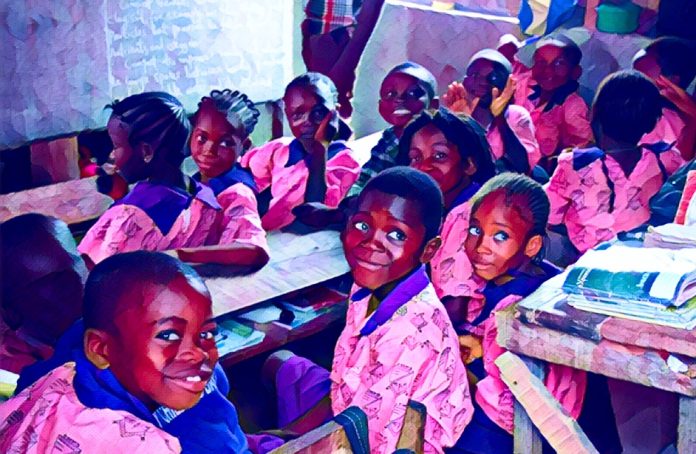
For many Nigerian parents, the start of a new school term no longer brings excitement — it brings anxiety.
With private school fees now climbing to record highs, more families are quietly returning to cheaper options: local day care centers and informal “Jelesimi” classes.
“Jelesimi,” a Yoruba phrase meaning ‘let the household have peace,’ refers to small community lessons for children aged one to five.
These centers, once seen as low-cost stopovers for toddlers, are now back in demand.
Soaring school fees push parents to cheaper options
A few years ago, only working-class families relied on Jelesimi centers to keep their young children safe during work hours.
Today, even middle-class parents are enrolling their toddlers there as private school fees reach staggering levels — between ₦200,000 and ₦900,000 per term for kindergarten.
Mrs. Chizoba Darlington, who sells soup ingredients in Lagos, said she had no choice but to withdraw her two-year-old from a private school.
“I now take my child to a Jelesimi lesson on the next street where they collect ₦20,000 per term,” she told Economy & Lifestyle.
“What does a two-year-old learn that’s worth ₦400,000? I just need somewhere safe while I’m at work.”
Her story reflects a growing frustration among parents who feel private schools are “milking” families under the excuse of inflation.
Parents lament economic pressure, rising costs
For some, the financial strain is beyond imagination. Mr. Olorunfemi Bamikale, a bus driver, said he was shocked when a private school gave him a bill of ₦859,700 for his three-year-old twins.
“That’s the kind of money I should be using to buy land,” he said. “Even teachers in that same school don’t earn ₦100,000 monthly. It makes no sense.”
Bamikale said he has now enrolled his twins in a Jelesimi center and plans to move them to a public school when they’re older.
Many parents share similar experiences. Some are even delaying formal education for their toddlers until they can afford it.
The situation, experts warn, could widen educational inequality as economic hardship deepens.
Private schools defend rising fees
School owners, however, say the increases are unavoidable. Mrs. Aduramigba Okunbor, a private school teacher, told Economy & Lifestyle that schools face the same inflation pressures as everyone else.
“Goods and services are expensive. We pay more for everything — books, utilities, even cleaning materials,” she said.
“To maintain government-approved standards, schools must spend more, and that affects fees.”
A review of several fee lists shows that parents now pay for multiple charges: forms, books, uniforms, sports levies, development fees, and health trust contributions.
Still, the public mood is one of frustration. As one parent put it, “education is fast becoming a luxury, not a necessity.”
Education shouldn’t be a privilege
From a journalist’s standpoint, what’s happening is more than just an education story — it’s a reflection of the country’s growing inequality.
When parents must choose between sending a child to school and paying rent, something has gone wrong at the core of governance and economic management.
While Jelesimi centers offer short-term relief, they cannot replace structured early education.
Unless the government intervenes to regulate fees or support struggling families, Nigeria risks raising a generation of children left behind by circumstance.
Education should not be a luxury; it should be a right — and one the nation must urgently protect.

