

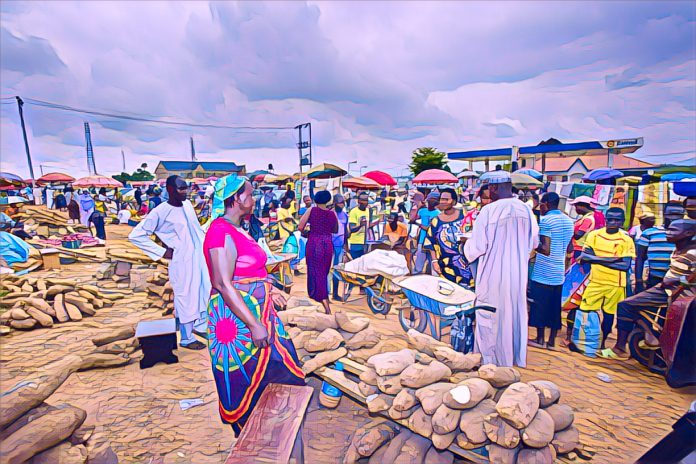
The drop in food prices has been devastating for Musa Abdullahi, a member of the Commercial Farmers Association of Nigeria in the FCT.
Musa Abdullahi, who has been successful in distributing farm produce across states for nearly a decade, has experienced a decline in his fortune.
“In Nigeria, consumers don’t understand the huge cost of commercial farming,” he said. “This government is turning things against farmers.
There’s no empowerment or support. They’ve opened borders and allowed junk food into the country.”
He accused the administration of President Bola Tinubu of ignoring the needs of local farmers.
Abdullahi claimed that food production thrived during former President Muhammadu Buhari’s tenure, when border closures encouraged local cultivation.
Other farmers share his frustration. Many invested heavily this year, expecting stable or higher prices. Instead, the sudden crash wiped out their profits.
Traders Struggle to Recover Investments
In Karu Market, Mrs. Erica Francis, who sells yam, rice, and beans, looked weary as she described her losses.
“We bought 50 kilograms of beans at N300,000. Now it’s below N150,000,” she said. “A bag of rice that cost N120,000 now sells for about N45,000.
I was hoping to finish my family’s house with the profit, but now I can barely pay school fees.”
The collapse has also hit storage businesses. Sylvester George, a member of the Food Storage Association, said he borrowed money from the bank to buy stock.
“The bank has already called to remind me about repayment,” he said. “This year is different. My life is in God’s hands.”
Consumers Welcome Cheaper Prices
While producers are in distress, consumers see the price decline as long overdue relief.
Michael Onoja, a father of five, said families can now afford to eat better.
“During Buhari’s time, people suffered just so a few farmers could make money,” he said.
“Now, a mudu of rice goes for N1,300, beans for N1,400. A 50-kilogram bag of rice sells around N45,000. That’s a huge drop.”
For many households, the change means being able to plan meals without the constant worry of soaring prices.
Mrs. Lucy Olu-Kayode, a civil servant, believes the shift is fair.
“Farmers made money when everyone else was crying,” she said. “Now the tables have turned. Not everyone can be happy at the same time.”
Uncertain Future for Farming
Some farmers are already considering quitting.
“I’m not planning to go back next year,” said Usman Lerre, who farms in Jikwoyi. “It doesn’t make sense to spend on fertilizers, chemicals, and labour only to sell at a loss.”
Elder Cyril Nchekwaram, a retiree turned trader, also regrets his timing.
“I started this business after retirement, thinking it would sustain me,” he said. “But we’re selling below cost. It’s not what I hoped for.”
The divide between farmers and consumers highlights a deeper problem in Nigeria’s food system.
Price swings are hurting producers while offering short-term relief to the public. Unless policy balances both sides, the coming planting season may see fewer hands on the fields — and the next crisis may not be falling prices, but scarcity.

