

KEY POINTS
-
Vice President Kashim Shettima asserted that challenging President Tinubu in 2027 would be futile, describing any potential rival as a “fool” or an “imposter,” and downplayed the electoral influence of social media campaigns.
-
The confidence is based on the APC’s incumbency advantage and its bet on long-term gains from current economic reforms, but it is immediately challenged by opposition parties who label the claims as arrogant and out of touch with widespread public hardship.
-
Political analysts suggest the remarks are aimed at rallying the APC base prematurely, noting that the election will likely hinge on tangible issues like the economy and security, with a fragmented but active opposition seeking to coalesce into a credible threat.
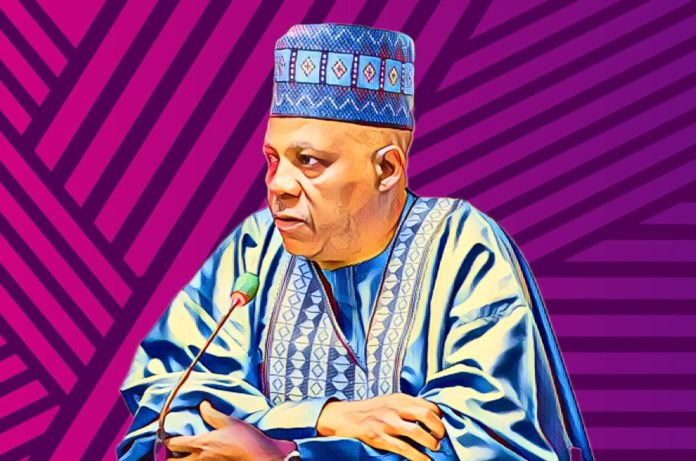
Vice President Kashim Shettima has issued a bold declaration of electoral invincibility for the ruling All Progressives Congress (APC), stating that only a “fool” or an “imposter” would dare to challenge President Bola Tinubu in the 2027 presidential election.
The remarks were delivered during the 15th National Executive Committee meeting of the APC held in Abuja, framing the next election as a foregone conclusion based on the party’s governance record and coalition strength.
Speaking to the party’s top echelons, Shettima displayed unwavering confidence, directly countering the growing online activism of opposition figures. “Only a fool hell-bent on a suicidal path or an outright imposter can dare to challenge President Bola Ahmed Tinubu in the 2027 election,” he stated.
He emphasized a traditional view of political power, downplaying the influence of digital campaigns. “Elections are not won by noise or nostalgia. Elections are not conducted… on Facebook, on Twitter. They are won by coalitions, credibility, and conviction.” Shettima framed the upcoming poll not as a contest but as an inevitability, concluding, “I believe that 2027 is not a gamble; it is a responsibility, and by the grace of God, we shall have a renewable blessing.”
Confidence Meets Reality: Analysts Question Premature Celebration Amid National Challenges
The Vice President’s supreme confidence is rooted in the APC’s control of the political machinery and a belief that President Tinubu’s contentious economic reforms, though painful, will eventually bear fruit.
The administration has staked its legacy on decisions like the removal of the petrol subsidy and the unification of exchange rates, arguing they are necessary for long-term stability. However, this assertion of an unchallengeable lead is met with skepticism by observers and outright rejection by a fragmented but active opposition.
Political analysts note that while incumbency offers significant advantage, Shettima’s comments may be premature. “Declaring victory three years ahead of an election is more about morale-boosting within the party ranks than a reflection of ground reality,” said Dr. Idayat Hassan, director of the Centre for Democracy and Development. “The administration is navigating severe economic headwinds—record inflation, a cost-of-living crisis, and widespread insecurity.
These are the issues that will ultimately shape voter sentiment, not political rhetoric.” The opposition Peoples Democratic Party (PDP), Labour Party (LP), and others have immediately seized on the remarks as evidence of arrogance. PDP spokesperson Debo Ologunagba retorted, “It is the height of delusion for a government presiding over unprecedented hardship to tell Nigerians they have no choice. 2027 will be a referendum on their performance, not a coronation.”
Furthermore, the political landscape is in flux. Key opposition figures like Atiku Abubakar (PDP) and Peter Obi (LP) remain influential, with Obi’s campaign having demonstrated a potent ability to mobilize youth and online voters in 2023—precisely the demographic Shettima’s comments seem to discount.
There is also ongoing talk of potential opposition coalitions seeking to present a unified front against the APC. Shettima’s dismissal of “social media” as a decisive factor ignores the potent role these platforms now play in shaping political narratives, especially among Nigeria’s vast youth population.
The coming years will test whether the APC’s “coalitions, credibility, and conviction” can outweigh the tangible daily struggles of millions of Nigerians. Shettima has set the stakes, framing 2027 as the party’s to lose. The opposition, meanwhile, is tasked with transforming online grievance and economic frustration into a viable electoral challenge.

)