

Key Points
- Governor Alex Otti commissions the rebuilt Omenuko Bridge in Abia, ending decades of fatal crashes that killed scores of people.
- The new bridge and 30-kilometre road unlock Abam’s farming economy, connecting produce directly to urban markets.
- Community leaders pledge N500 million toward Otti’s 2027 re-election, saying his works speak for themselves.
Mothers used to pray before crossing it. Drivers tightened their grip on the steering wheel. Traders stopped to weigh the risk against the value of their goods.
The old Omenuko Bridge over the Igwu River was not just structurally dangerous. It was a source of dread that had settled into the bones of an entire region.
That dread has a body count. In 2007, a bus carrying 17 young students on their way to write the Unified Tertiary Matriculation Examination plunged into the river. None survived. In December 2024, eight Christmas travellers died at the same spot. Between those dates and beyond them, other families buried their own.
On Feb. 13, 2026, that chapter closed.
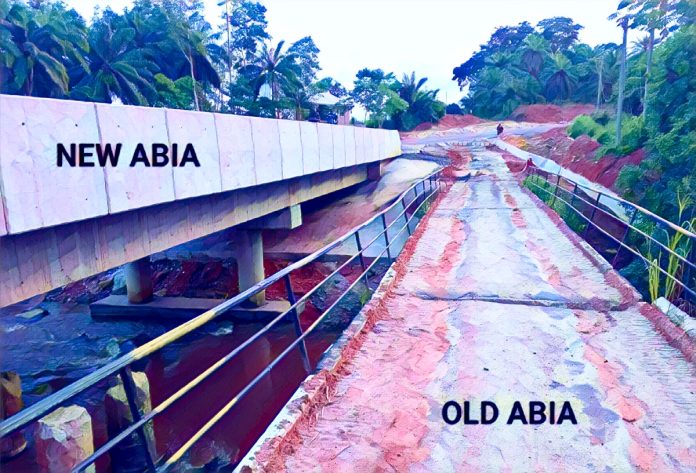
In a ceremony at Ozu Abam in Arochukwu Local Government Area, Governor Alex Otti commissioned the newly constructed Omenuko Bridge and the 30-kilometre Ozu Abam-Arochukwu Road. The twin projects marked a decisive turning point for Abam Onyerubi and neighbouring communities long cut off by broken infrastructure.
A minute of silence was observed for those who lost their lives at the river over the years.
A Death Trap With a Long Memory
The original bridge was built around 1959 under the government of Michael Okpara, during the colonial transition era. The Traditional Ruler of Okorie Ogori Abam Autonomous Community, Eze Evangelist Ogbuka Origa, traced the crossing’s origins even further back to a wooden log laid by Abam’s founding patriarch well over a century ago. That log eventually gave way to a narrow concrete structure that, by any modern standard, should have been replaced decades ago.
The bridge bears the name Omenuko after a well-known historical figure, Chief Igwegbe Odum of Arondizuogu in present-day Imo State, who suffered a tragic loss at the site. The name stuck and so, for far too long, did the danger.
The Omenuko Bridge directly connected over 23 communities, making it a vital transportation corridor for thousands of residents. It linked farms to urban markets, children to schools, and patients to hospitals. But for all that it connected, it terrified the people who depended on it.
Former Secretary to the State Government Prof. Kenneth Kalu said the people of Abam heaved a visible sigh of relief when the projects were completed. He was not exaggerating.
From Fear to Commerce
Abam is not a small or inconsequential community. It is one of Abia State’s most productive agricultural zones, home to large-scale rice, cassava, palm oil and plantain farming, as well as the state’s largest rubber plantation. The problem was never the land or the people. The problem was getting goods out.
“We have the strength and good soil to farm but there was no road to take our produce to the cities,” the traditional ruler said. “Now traders come to us and buy whatever they want. Our people are happy because we will now begin to make money through farming.”
President of the Inyom Abam Development Union, Lady Nne Oriona Ukaike Ukeh, put the economic stakes plainly. The new bridge and road would reduce post-harvest losses, increase household income and give more families the means to keep their children in school.
“Our farm produce will no longer get spoilt; we can now sell and support our families,” she said.
Rev. P.K. Emeaba, a prominent Abam indigene, offered a deeper historical perspective. He recalled that the Igwu River once functioned as a commercial artery long before any bridge existed, with up to 40 canoes at a time loading goods at Onu Anyim sea port for trade routes reaching Opobo, Cotonou, Cameroon and beyond. Tobacco, drinks, gunpowder, clothes and overseas goods arrived by the same route on the return journey.
“When they were coming back,” Emeaba said, “they brought their wares home from Abam through the pathways to their various communities.”
The reconstruction, he said, is nothing less than a restoration of that commercial dignity.
Otti, Promises and the Political Fallout
What distinguished this intervention from those of previous administrations was not ambition.
Several governors before Otti had promised to fix both the bridge and the road. Equipment was mobilised to the site on at least one occasion and then left to rust.
The bridge and road appeared in budget lines and speeches for years without materialising.
Lawmaker Uchenna Okoro, who represents the constituency at the Abia State House of Assembly, recalled administrations that repeatedly awarded, flagged off and even “commissioned the bridge and road only on air.” He said that when you visited the site, there was nothing on the ground.
Gov. Otti, who titled his commissioning speech “At Last, the Jinx Is Broken,” described the projects as testimony to his government’s determination to address decades of neglect and set a new governance standard.
He did not frame the intervention as charity. He called it justice delayed. “While we have turned the corner, we must acknowledge the pain families endured due to leadership failure,” he said at the ceremony.
“Today, we have turned the page. The nightmare is over, the siege has collapsed, the jinx is forever broken.”
He also acknowledged the communities beyond Abam that depend on the road corridor, including Ohafia, Arochukwu, Ihechiowa and Isu, where the collapse of road infrastructure had caused compounding economic losses.
The political consequences appear to be arriving alongside the concrete. Chief James Umeh, a prominent Abam son, publicly announced a pledge of N500 million as seed money toward Otti’s 2027 re-election campaign at the commissioning event itself. Residents and lawmakers spoke in similar terms.
“Otti has finished every campaign he needs to do here,” Ukeh said. “In 2027, he does not need to come to Abam to campaign. His works will speak for him.”
Emeaba made the same point more simply: “Since I was born, I have never seen that type of crowd in Abam before. That was to show how the people appreciated what the governor did for us.”
The adage that there is no easy road to Arochukwu, the historic Aro Kingdom, is now officially retired. There are several, and they are paved.

