

Key Points
- Illegal miners in Bani community, Kaiama pay security officials between N20,000 and N30,000 per trip to stamp fake permits and guarantee safe passage for lithium-loaded trucks heading to Ogun State.
- Chinese buyers fund the lithium procurement at the village level while truck drivers pay police, customs officials and local vigilantes ground commissions to move the ore freely across state lines.
- Sources say some terrorists operating in Kaiama have agents directly involved in the lithium trade, using illegal mining as a revenue stream while massacring over 100 civilians in nearby communities.
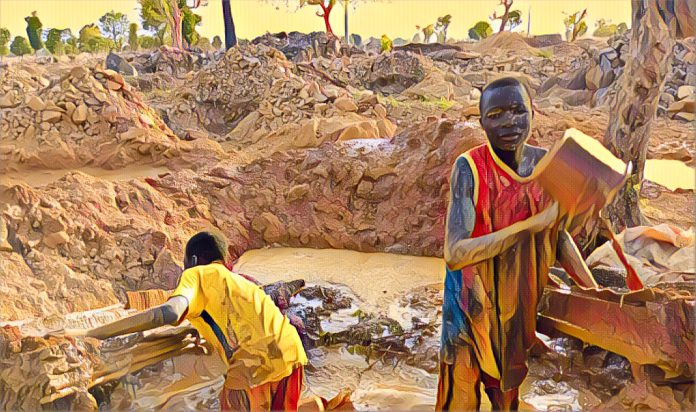
The trucks move mostly after dark. They roll through Bani community loaded with bags of lithium ore, sometimes two, three trips a week, heading south toward Ogun State while the rest of Kaiama Local Government Area buries its dead.
Terrorists have killed over 100 people in this stretch of Kwara State in recent weeks. Women and children are still being held for ransom. And yet, the mining never stopped.
This is what an embedded reporting trip to Kaiama found: a thriving, open, illegal lithium trade operating in the shadow of one of Nigeria’s deadliest terror surges, propped up by bribed security officials, coordinated through WhatsApp groups, and connected to Chinese buyers who fund the whole operation from a distance.
Where the Ore Comes From
Bani community was, by most accounts, an unremarkable town before lithium changed everything roughly three years ago.
The global push toward renewable energy sent demand for the mineral soaring, and prospectors descended on Bani and nearby communities, including Daba, a settlement with mining sites that cut deep into the old Oyo National Park.
The miners are largely non-Yoruba speakers from other states. Early on, their relationship with local Yoruba transporters turned violent. Clashes were deadly. But profit is a powerful mediator.
“That is no longer the case,” said one illegal miner who declined to give his name. “All of us are working together now because fighting will not allow us to get money from buyers.”
A local businessman from Bani who lives in Ilorin and owns two trucks explained how the logistics work. Once a consignment is ready, each bag is marked to identify the receiving agent and the collection point.
Transportation costs for a 50-kilogram bag of lithium ore from Bani to Ogere or Sagamu in Ogun State run between N1.5 million and N1.9 million per load.
The ore itself, sold by the ton, fetches over $70,000 on the international market. Hundreds of trucks move out of the area without any official record.
“The financial loss is immense,” said one dealer, who asked not to be named. “A ton of lithium sells for over $70,000, yet hundreds of trucks of lithium are illegally moved out of the state without record.”
The Permit Racket
The miners are not operating in secret, exactly. They are operating with a system.
Multiple miners described a permit arrangement that keeps law enforcement off their backs. The permits are not official. They are not issued by any regulatory authority. They are, by every description gathered during this reporting, bribes dressed up in paperwork.
“We pay between N20,000 to N30,000 for a permit per trip,” one miner explained. “The officer, either police, NSCDC officer, customs or immigration, on duty will just put a stamp on a paper with the date and give it to us.
With this, there’s no security official we meet on the road and show the paper that will disturb us. But the permit only lasts a trip.”
The Kwara State Government confirmed that mining in the area is unlicensed. The spokesperson for the Nigeria Security and Civil Defence Corps in Kwara State, Michael Ayoola, flatly denied the corps issues such permits.
“We don’t have business with illegal miners, we are all out to arrest them,” he said.
But a senior official in the NSCDC state command, speaking anonymously, offered a different picture. He said miners pay “appreciation” to security officers who provide cover during operations, and suggested this was not unusual.
“The miners do appreciate security officers who gave them cover towards a successful operation,” he said, “and I don’t think that is out of place apart from the official remuneration.”
A separate security source said it is the Federal Ministry of Mines and Development that issues mining permits, not state-level security agencies.
Chinese Buyers and Ground Commissions
Truck driver Segun Alolade described the operation with the matter-of-fact tone of someone discussing a routine logistics job.
Chinese buyers, he said, give money to village-level contacts who procure the lithium ore directly from miners. Once the ore is secured, drivers from Ilorin are called in to move the goods south. Transportation costs, he said, range from N1.9 million to N2.3 million depending on road conditions.
Moving the consignments requires paying what those in the trade call “ground commissions” to police officers, customs officials and local vigilantes stationed along the route.
“We pay ground commissions to security agencies, including policemen, officials of the Nigerian Customs Service, and local vigilantes, to guarantee easy passage,” Alolade said.
“Once the minerals are ready, drivers from Ilorin are summoned to transport the goods to destinations in Ogun State.”
The miners also maintain a dedicated WhatsApp group where drivers connect with buyers and sellers, permit arrangements are discussed, and security payments are coordinated.
The Terror Question
The most unsettling dimension of the Kaiama mining story is its proximity to active terror.
Coordinated attacks on Woro and Nuku communities in Kaiama last month killed between 78 and 170 people, depending on the source.
The wide range reflects the chaos of the aftermath and the difficulty of counting bodies in communities that buried many of their dead in mass graves. Dozens more were abducted.
A video circulated showing women and children pleading for rescue as their captors demanded ransom.
And yet, dealers and drivers working the lithium trade said their operations were untouched.
“We have been going on with our work there without any interference,” said dealer Ibrahim Farouk.
When pressed on whether the miners had some understanding with the terrorists, Farouk chose his words carefully. “I can’t call it a deal but the thing is that we know them and they understand the kind of job we do.
There’s no way we are disturbing them and we are not their targets either, so we don’t expect that they’ll come and attack us. Although, some of them who don’t know us come after us once in a while.”
Sources within the area said the reason illegal mining continues undisturbed is more direct than a passive understanding.
Some of the terrorists, they said, have agents actively engaged in the lithium trade, using the mining business as a revenue stream.
Driver Kokoma Ahmed, who makes two trips a week between Ilorin and Bani, said he has never been attacked or had miners in his vehicle abducted. “They do their business unhindered,” he said.
What the Farmers Lost
The human cost of the mining does not only come from terrorists.
Farmers in and around Bani say the miners have consumed their land. Mining sites expand acre by acre into farmlands in remote communities where there is no government presence to intervene and no authority to appeal to.
“Even when we get to the farm early, once the miners come and start their mining, we can no longer farm,” one farmer said, his voice carrying the exhaustion of someone who has repeated this complaint to no one in particular for a long time.
“Worse, they sometimes stay until very late when we can no longer even farm.”
What Should Happen Next
A community leader in Kaiama, Alhaji Mohammed Abdulazeez, argued that an outright ban on mining is not the answer.
He said mineral resources are gifts that should benefit the country, but that the federal government needs to properly regulate operations and provide security so the wealth reaches national coffers rather than disappearing into private trucks headed south.
It is a reasonable position in the abstract. In practice, what exists in Bani is the opposite of regulated. It is a system designed to ensure that the wealth flows out and accountability never comes in.
The trucks keep moving. The ore keeps leaving. The permits keep getting stamped. And somewhere south of Kaiama, the lithium changes hands again, bound for markets that have no interest in how it got there.

