

KEY POINTS
- The Economist questions how much of the technical expertise inside Dangote’s empire is actually African.
- Most managers at the Dangote Petroleum Refinery are Indian nationals; cement operations rely on China’s Sinoma.
- Dangote disputes the characterisation and says his automation proves genuine innovation.
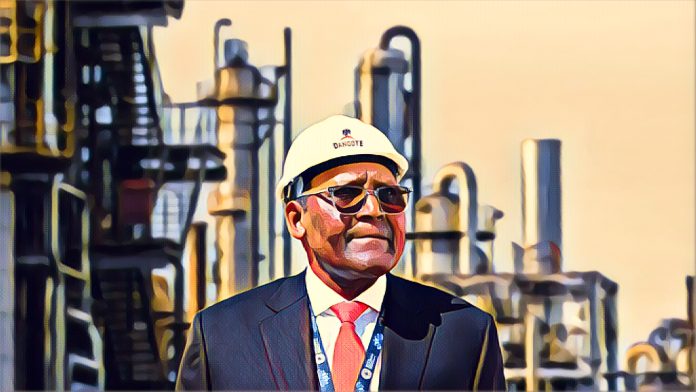
Aliko Dangote says his companies are “very, very innovative.” The Economist spent time with Africa’s richest man at his Lagos office earlier this month and came away unconvinced.
In a profile published March 17, the British weekly posed a pointed question about the inner workings of Dangote’s $28.5 billion empire: for all its industrial scale, how much of the technical brainpower running it is actually African?
Political access and protected margins
The Dangote innovation Economist critique centres on a straightforward observation that his companies remain heavily dependent on foreign subcontractors for technical and high-skilled work across construction and ongoing maintenance. Most of the managers running the 650,000-barrel-a-day Dangote Petroleum Refinery outside Lagos are Indian nationals. The cement business, which forms the financial backbone of the entire group, has a longstanding operational relationship with Sinoma, a large Chinese company.
Dangote pushed back. He pointed to heavy automation at both the refinery and his cement plants as proof of genuine innovation. The magazine did not find that argument fully persuasive. The underlying critique is not about automation, which any sufficiently capitalised company can purchase and install. It is about whether the technical and managerial capacity to run those facilities is building up inside Nigeria or simply arriving from abroad alongside the equipment.
A broader examination of Dangote’s empire
The Dangote innovation Economist critique sits inside a broader examination of how his empire grew. A leaked US government cable from 2005, cited in the profile, described his fortune as built on family connections and political relationships, noting he held exclusive import rights for cement, sugar, and rice at various points. His cement business expanded partly behind import bans on the very product he once brought into Nigeria from overseas.
The Economist noted that his cement profit margins can run at more than twice the rate of rival multinationals even in frontier markets, and critics quoted in the piece attributed that gap at least partly to tax breaks and regulatory protection.
According to Billionaires Africa, Dangote disputes that reading. He argues the margins reflect operational efficiency and points out that he built things no government or rival was willing to build. On the refinery specifically, he said it received no government incentives and that he personally paid $100 million for the land.
The expansion plan and what it demands
What makes the innovation question consequential is the scale of what Dangote has promised next. He has told investors and governments that he plans to expand the refinery’s capacity over three years to roughly half of Saudi Arabia’s combined refining output. He has announced a $2.5 billion fertilizer joint venture in Ethiopia, $1 billion in cement and power investments in Zimbabwe, copper processing ambitions in Zambia, and cocoa processing plans in Ghana and Ivory Coast. Each of those commitments demands not just capital but deep technical execution and institutional knowledge that takes years to build locally.
Dangote ended the interview heading toward another meeting, characteristically direct about what his critics will see when they return. “When you come back in three years’ time,” he further told The Economist, “what you’ve seen today, it will be three times that.”

