

Key Points
- Hundreds of thousands of Benue residents remain in IDP camps years after herdsmen attacks forced them from their farmlands
- Displaced residents reject aid-only responses, demanding the federal government restore security and allow safe returns
- Analysts warn that abandoned Benue farmlands are driving food price increases across Nigeria as harvests go unplanted
Long before dawn breaks over the plains of Benue, the camps are already awake.
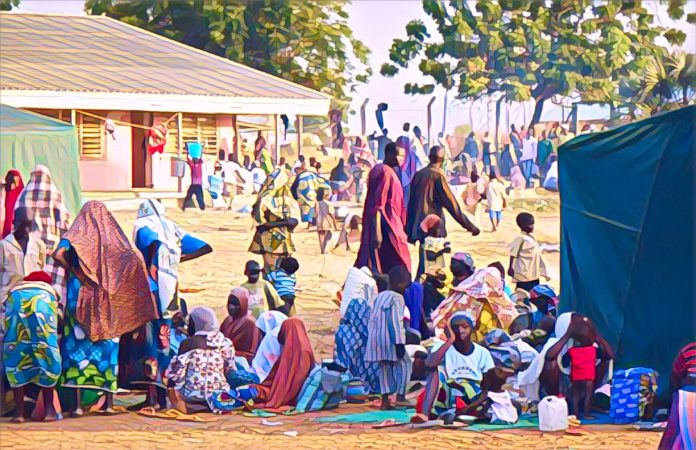
Mothers coax fires to life over damp ground. Babies cry in makeshift cots soaked by overnight rain.
Children drift toward open-air classrooms, hoping a volunteer teacher will arrive. Tarpaulin shelters, held together by rope and fraying cloth, stretch as far as the eye can see.
This is home. Or the closest thing left to it.
Nigeria’s tally of internally displaced persons stands at more than 3 million. Benue State, once the country’s self-described food basket, accounts for close to half that number — hundreds of thousands of people scattered across camps and forgotten settlements, many of which were never designed to be permanent.
A life dismantled overnight
Terdoo, a farmer who declined to give his surname, recalls a life ordered by seasons, not survival. He woke before sunrise because the land demanded discipline, not desperation. His yam barns were full. His children ate without complaint.
“Hunger came and went,” he said. “It was never like this.”
The violence arrived gradually, then all at once. Distant attacks became rumors. Rumors became familiar names. Fields were abandoned mid-harvest. Then, one night, there was no time to decide.
“Fire everywhere. People shouting,” he said. “You do not pack your life in that moment. You run.”
He paused.
“You carry your body. That is all.”
Today, Terdoo still wakes before sunrise. But there are no fields, no barns, and no certainty. Only waiting.
‘We are asking for our lives’
Jerry lost her husband, children, and mother on the night of June 13, 2025, when attackers burned her community in Yelwata.
More than 200 people died that night. She now tends a small vegetable patch at the edge of the camp, coaxing stubborn green shoots from cracked soil.
“They think we are waiting for food,” she said. “We are waiting for our lives.”
Teryima, who lost all his children in a separate attack, stood nearby and listened. When he spoke, his voice was measured but firm.
“Stop sending words,” he said. “Bring back our land. Make it safe. Let us return without fear of being killed in our sleep.”
He looked across the rows of plastic shelters.
“If you cannot protect the land, then say it. If you cannot take us home, then say it. But do not leave us here and pretend this is living.”
A national wound with a growing cost
Benue’s abandoned farmlands carry consequences well beyond the state’s borders. Markets that once moved produce across the country have thinned.
Food prices have risen steadily. Every missed planting season represents a compounding national loss from a region that historically fed millions of Nigerians.
Security guarantees sufficient for safe return have not materialized. Resettlement frameworks remain underfunded or absent entirely.
Land left behind sits unprotected, leaving room for occupation and entrenched fear.
As the 2027 election cycle accelerates campaign activity, promises are multiplying. But the camps remain.
Some have existed long enough that children who arrived clinging to their mothers have grown into adults in the same dust, some now raising children of their own, children born into displacement who have never seen the villages that exist only in family stories.
“I will go home,” Jerry said, when asked what she would do if she could leave today. “Even if nothing is there, I will stand on that ground.”
Teryima nodded.
“I want to stand where my house stood,” he said. “That is enough to begin.”
Until that return is possible, advocates and residents alike say no policy speech or campaign promise will carry meaning in Benue.
These camps were never meant to be permanent. They were meant to be a bridge between loss and return. For many, that bridge has not been built.

