

Key Points
- Sterling Bank hosts inaugural Nigeria Transport and Logistics Summit.
- Logistics market holds N15 trillion in potential economic value.
- Suleiman calls for bold execution across public and private sectors.
Abubakar Suleiman, managing director and chief executive officer of Sterling Bank, did not come to Lagos to talk about potential. He came to push for action.
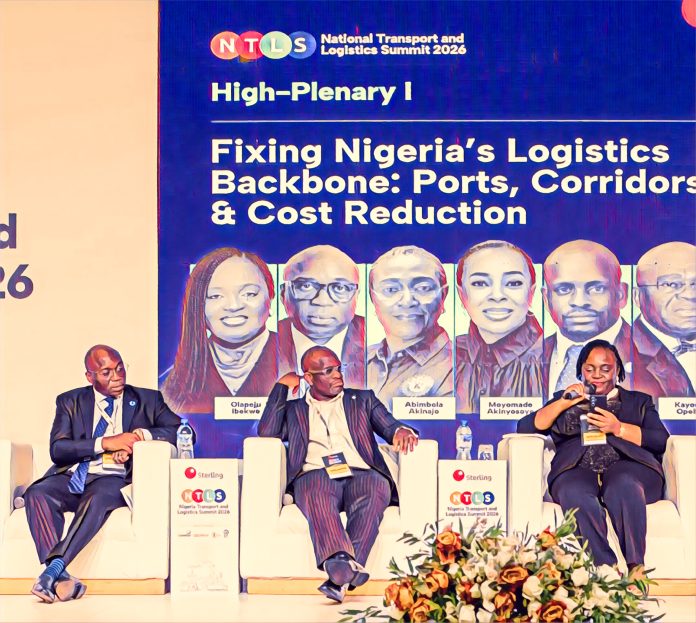
Represented at the inaugural Nigeria Transport and Logistics Summit by Sterling One Foundation CEO Olapeju Ibekwe, Suleiman told industry leaders, policymakers and financiers gathered at Eko Hotel and Suites that Nigeria’s transport logistics sector has endured enough diagnosis. What it needs now is execution.
The summit, hosted by Sterling Bank under the theme “Funding the Engine of Growth,” framed transport, mobility and logistics as an underperforming pillar of economic growth that can no longer afford to wait.
A sector too big to keep underperforming
Furthermore, the numbers back that framing up. Nigeria’s logistics subsector contributes roughly N1 trillion annually to gross domestic product. While the broader transport and logistics market carries potential value exceeding N15 trillion. Yet the sector claims just under 4 percent of GDP, a gap experts at the summit described as a long-running structural failure.
“We must move beyond diagnosing the problem to building integrated, modern logistics systems that can power productivity at scale,” Suleiman also said. “This means fixing our ports, strengthening logistics corridors, improving road and rail connectivity, and embedding efficiency across the value chain.”
Nigeria’s trade competitiveness is at stake
Darlington Nwankwo, divisional head of renewable energy, mobility and tourism at Sterling Bank, put the sector’s importance in terms of what it enables across the broader economy rather than what it contributes directly.
“Nigeria’s trade competitiveness is directly linked to the efficiency of its logistics corridors, from ports to inland distribution networks,” he said. “We must be deliberate about fixing the logistics backbone of the economy if we are to unlock the growth we need.”
Suleiman’s closing argument captured the summit’s overall tone. Finally Nigeria has spent years documenting what ails its transport logistics sector. The inaugural NTLS 2026 was Sterling Bank’s opening push to turn that documentation into a blueprint for building something better.

