

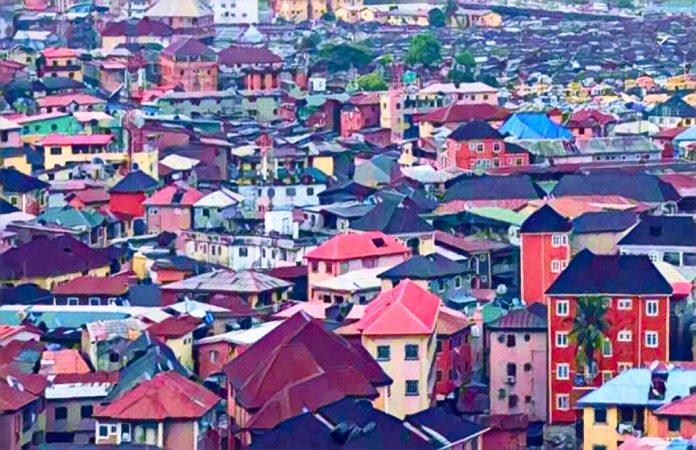
Key Points
- Nigeria’s housing deficit has reached 14.9 million units, and experts say the country needs to build at least 550,000 units annually for the next decade to close the gap.
- Tenants in Lagos, Abuja, Port Harcourt and other cities are facing rent increases of 40 to 500 percent, often without notice or any property improvements.
- Unregulated estate agents are compounding the crisis by encouraging landlords to raise rents aggressively while charging fees that sometimes exceed 20 to 30 percent of annual rent.
The notice came on a Tuesday morning, not on official letterhead, not delivered in person. It arrived as a WhatsApp message from an estate agent: “Your rent is now N1.8 million. If you can’t pay, vacate before month end.”
Adaobi had lived in her two-bedroom flat in Egbeda with her husband and two children for four years. She moved in when the rent was N750,000. It had risen to N950,000. Now, without a single repair, without negotiation, it had nearly doubled.
“I read it three times,” she said, sitting on a plastic chair in the compound she may soon leave. “I thought maybe it was a mistake.”
It was not a mistake. Across Nigeria’s largest cities, it is a pattern.
A crisis playing out in every city
From Lagos to Abuja, Port Harcourt to Kano, families are being pushed out of neighborhoods they have lived in for decades. Rents that held at N250,000 a few years ago are now crossing N1 million.
Apartments that cost N550,000 in Port Harcourt’s Abuloma district before the current administration have surged by 500 percent.
In Kubwa, one of Abuja’s expanding suburbs, David Emmanuel, a salesman transferred from Sokoto, watched his rent climb from N400,000 to N700,000, then to N1.5 million.
In January, his landlord’s agent sent a letter: pay N2.5 million by July “or consider this notification as the landlord’s notification to repossess his property.”
“I now believe it when I read that a former FCT minister said Abuja is not meant for everybody,” Emmanuel said.
The math is brutal
Ekene Nwonye, a 29-year-old graphic designer in Yaba, earns N220,000 a month. His rent is N900,000 a year. He has moved into a shared apartment with three other adults.
“We are all educated people,” he said. “But we live like students because rent won’t let us breathe.”
In Akure, Ondo State, Musa Dauda, a broadcast engineer earning N80,000 monthly, is supporting a wife, two children and two other dependants.
When his landlord raised his rent from N165,000 to N265,000, he pleaded for time to find another place. The landlord told him to leave immediately if he could not pay. His lawyer is now involved.
Samuel Okere, a 67-year-old retired civil servant in Ajegunle, Lagos, is preparing to leave the city entirely after his landlord raised rent from N400,000 to N900,000. “My pension cannot fight,” he said.
Agents and a system built on fear
Estate agents sit at the center of the crisis, many operating without meaningful regulation. Tenants describe a consistent pattern: agents pressure landlords to raise rents citing inflation or exchange rates, then stack on multiple fees including agreement charges, caution deposits and commissions, sometimes adding up to 30 percent of annual rent on top of the base price.
“Agents now tell you, ‘If you don’t take it, five people are waiting,'” said Bose, a single mother in Ikorodu. “Sometimes they are lying. But fear makes you agree.”
An agent in Surulere, speaking anonymously, acknowledged the dynamic plainly. “Everybody wants to cash out,” he said. “Landlords complain of costs, agents want commission, and tenants are stuck in the middle.”
A deficit the country cannot ignore
Nigeria’s housing gap now stands at 14.9 million units. Experts say the country needs to build at least 550,000 units annually over the next 10 years to close it. World Bank and Bank of Industry data suggest the funding required to bridge that gap could exceed N59 trillion.
Lagos alone has a shortfall of roughly 3.4 million units, driven by rapid migration and a population density 10 times the national average. Nationwide, only about 32.5 percent of urban Nigerians own their homes, while more than 49 percent rent, leaving millions exposed to arbitrary evictions and unchecked price spikes.
Nigeria’s mortgage-to-GDP ratio sits below 1 percent, compared to 80 percent in the United Kingdom and 30 percent in South Africa. Mortgage loans, when available, can carry interest rates as high as 25 percent.
Some states are trying to act
Enugu State’s House of Assembly has passed a bill through public hearings that would cap agency fees at 10 percent, eliminate caution fees and require agents to be certified. Ebonyi State is at a similar legislative stage.
Lagos State’s housing authority says tenants can take unreasonable rent increases to court, though legal practitioners note that process is slow, expensive and rarely used by people who still need somewhere to sleep.
What will change things
Analysts say reversing the trend requires more than legislation. They are calling for mass affordable housing delivery, land administration reform, expansion of the National Housing Fund, and incentives to lower the cost of building materials through local sourcing.
Some advocate slum upgrading programs over demolitions as a faster, cheaper path to improving conditions for millions already living in informal settlements.
Until those changes arrive, the exits from Nigeria’s cities are getting crowded.

