

KEY POINTS
- Hundreds of residents, including women, children and elderly people, have fled Unguwar Lalle in Sokoto’s Sabon Birni LGA following renewed insecurity and suspected bandit attacks.
- Displaced families reportedly left with livestock and limited belongings, while residents accused authorities of failing to protect communities despite repeated attacks and killings.
- The fleeing residents are calling for urgent security and humanitarian intervention to restore peace and enable displaced families to safely return home.
Hundreds of residents, including women, children and elderly people, have fled Unguwar Lalle community in Sabon Birni Local Government Area of Sokoto State following renewed attacks and worsening insecurity blamed on suspected bandits.
The mass displacement has left families abandoning their homes, farms, livestock and other belongings as they search for safer locations amid growing fears of further attacks.
The affected residents have also accused the government of failing to provide adequate security and abandoning rural communities to their fate despite repeated attacks and killings in the area.
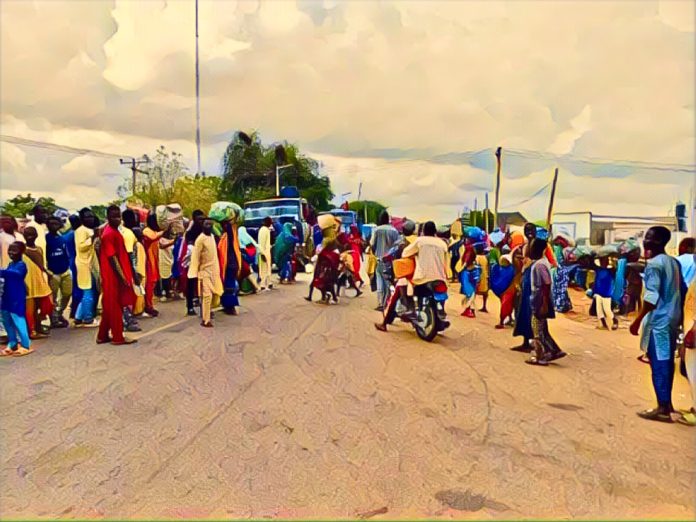
Footage obtained from the affected community showed scores of displaced residents moving away from Unguwar Lalle in large numbers.
Some of the residents were seen trekking through difficult terrain, while others travelled on motorcycles with family members and a limited number of belongings they were able to take with them.
Several families also moved with goats, cows and donkeys, highlighting the extent to which residents were forced to evacuate without knowing when, or whether, they would be able to return to their homes.
Some of the fleeing residents reportedly headed towards a river where canoes were waiting to transport them to locations they considered safer.
The movement reflects the increasingly difficult conditions facing rural communities in parts of Sokoto, where insecurity has disrupted normal life and forced residents to abandon sources of livelihood.
Resident accuses government of abandonment
One of the displaced residents, speaking in Hausa in a video seen by SaharaReporters, said the community had reached a point where residents no longer felt protected.
He described insecurity as the most pressing challenge facing the people, saying families were struggling to survive amid attacks, hunger and the loss of their homes and livelihoods.
According to the resident, residents could endure food shortages and other economic difficulties, but the absence of security had made life in the community increasingly unbearable.
He accused the government of failing to respond adequately to the plight of residents despite the continued insecurity.
The resident said the people had supported the government but now felt abandoned because they were being left to cope with the consequences of persistent attacks without adequate protection.
The displaced resident claimed that Unguwar Lalle had been severely affected by the insecurity, with residents from the community and neighbouring areas forced to leave their homes.
He said the displacement had resulted in widespread hardship, hunger and uncertainty, leaving many families moving from one location to another in search of safety.
He also alleged that people had previously been killed in attacks but that authorities failed to take sufficient action to prevent further violence.
The resident appealed to the authorities to visit the affected communities and witness the conditions under which displaced families were living.
He called for urgent assistance, saying residents had reached the limits of what they could endure and needed protection as well as humanitarian support.
The crisis is reportedly not limited to Unguwar Lalle, as residents also pointed to displacement from Sabon Birni and surrounding communities.
The movement of families from multiple communities points to the broader security challenges confronting rural populations in the area.
For residents whose livelihoods depend heavily on farming, livestock and local trade, displacement means more than simply leaving their homes. It also threatens their ability to cultivate farmland, maintain livestock and generate income.
The loss of access to farms and other productive assets could deepen food insecurity and economic hardship for already vulnerable households.

