

Key points
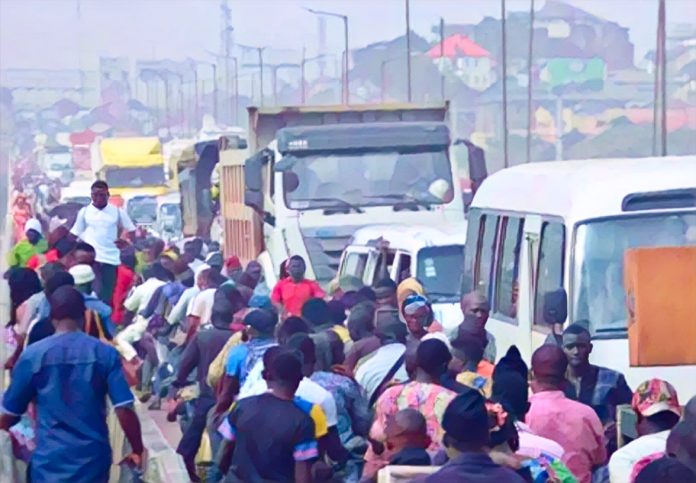
- A two-week repair of Kara Bridge expansion joints, begun Sept. 8, has stretched gridlock about 15 kilometers into Lagos, with some motorists stuck for close to six hours.
- The same joints were partly repaired in 2025 and again during a six-week closure from February 2026, and a July repair was postponed after motorists complained.
- Ogun Federal Controller of Works Michael Komolafe says the current fix uses stronger concrete and should last at least 10 years, but blames trucks carrying up to 90 tons on roads built for 60.
LAGOS, Nigeria: Ogun State Federal Controller of Works Michael Komolafe has promised that the latest repair of Kara Bridge on the Lagos-Ibadan Expressway will hold for at least a decade, as motorists endure a third round of work on the same expansion joints in 14 months.
The Federal Ministry of Works announced the two-week job on Sept. 5, after a July start was suspended over traffic concerns.
When crews moved in on Tuesday, Sept. 8, traffic backed up from the bridge in Ogun State past the Secretariat Bus Stop and, by nightfall, about 15 kilometers into Lagos. Motorists heading for the Otedola underpass from Ikeja and Agege were caught in it too.
Police, soldiers, LASTMA, the Federal Road Safety Corps and Ogun’s traffic agency were all deployed, but that did little for people sitting still. Some travelers bound beyond the bridge spent close to six hours in the jam.
Commuters look for a way around
Saheed, who lives in Mowe and works on Lagos Island, got home around 2 a.m. on the first day. He said he may switch to the Lekki-Epe or Ikorodu routes.
Another motorist, Timilehin Adio, said he was weighing the same detours through Sagamu and Ikorodu. “The traffic is becoming unbearable,” he said.
Others with offices on the Island have considered sleeping at work or renting rooms in Lagos until the repair ends.
The work is being done in phases. Half of the affected section is closed while vehicles squeeze through the other half, and crews will then swap sides.
Why the joints keep failing
Punch first reported damaged expansion joints at Kara in July 2025. The ministry began repairs, then stopped after complaints about congestion, leaving half of each side done.
In February 2026 it ordered a six-week partial closure to finish Kara, Magboro and Arepo-Punch bridges, saying the joints had deteriorated enough to cause crashes. Another attempt scheduled for July 28 was postponed.
Built-environment professional Babatunji Adegoke said joint wear is normal on a road this busy, but repeated failures should prompt a review of design, materials, installation, drainage and loading, and a shift from reactive to preventive maintenance.
Assistant chief civil engineer Bright Ezeonye went further, saying repeated repairs of the same component raise questions about the quality and supervision of earlier work, and that a proper traffic impact study should have come first.
Komolafe insisted the current repair is durable. He said the ministry is using a special high-strength concrete that reaches working strength in seven days instead of the usual 28, because there is no alternative route to close the bridge fully.
The bigger problem, he said, is overloading: roads designed for 40 to 60 tons are carrying trucks of 80 or 90 tons. Under normal conditions, he said, the joints should not need another traffic-related repair for at least 10 years.

