

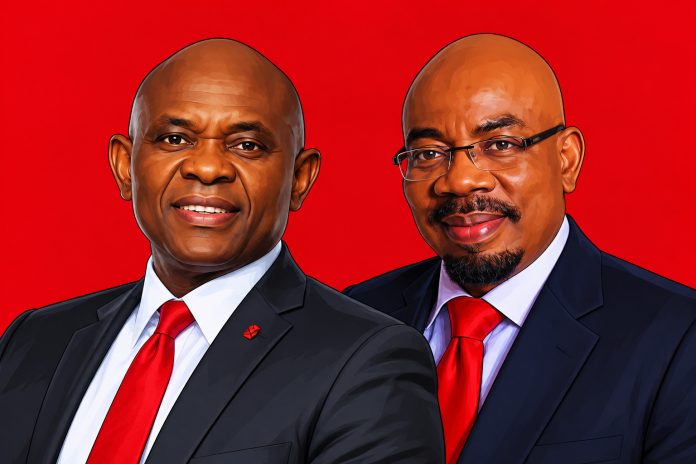
Jim Ovia, the founder of Zenith Bank, and Tony Elumelu, the longtime chairman of United Bank for Africa, were pushed out of their banks under the Central Bank of Nigeria’s crackdown on loans to insiders, according to a central bank official.
The official said Ovia’s exit was tied to loans he took from Zenith that were connected to luxury apartment towers he is building in Lagos and to other ventures. The official asked not to be named because they were not authorized to discuss supervisory matters, and did not give the size of the loans. Elumelu’s departure from UBA was also linked to insider credit, the official said.
Both banks gave a different reason. Zenith announced on May 5 that Ovia had retired as chairman after completing the 12-year tenure limit for directors of financial holding companies, and that Mustafa Bello, a former commerce minister and Zenith director, had taken over from April 27. UBA said in July that Elumelu would retire as chairman on Aug. 21 after 12 years and named Emmanuel Nnorom as his successor. Neither bank mentioned insider lending.
The central bank has now acknowledged that its insider credit rules are forcing people out, though it has named no one. Olubukola Akinnwunmi, the central bank’s director of banking supervision, said stricter monitoring of insider loans had led some bank owners, shareholders and board members to leave the industry, Nairametrics reported on Thursday. He made the remarks at the 38th Seminar for Finance Correspondents and Business Editors in Abuja.
“The bank is strictly monitoring that,” Akinnwunmi said, according to Nairametrics. He warned that directors who keep breaching insider credit limits could lose their board seats. “We will follow the rules to the letter.”
Enforcement of insider credit rules, large exposure limits and single obligor limits had reached an unprecedented level, he said. “Bank failures are often preceded by governance weaknesses rather than capital deficiencies alone,” Akinnwunmi said. He added that “corporate governance is the bedrock of resilience.”
Before the crackdown, some banks had secured central bank approval for insider loans without clear deadlines to bring them into compliance, Nairametrics reported. That left room for regulatory arbitrage.
The rules come from a February 2025 circular. It gave banks 180 days to bring loans to directors, major shareholders and their companies within the limits set by Section 19 of the Banks and Other Financial Institutions Act of 2020. It also ordered directors whose related loans had turned non-performing to resign immediately.
Ovia’s towers
Ovia, 74, has spent the months since his exit promoting his property business. “Property beats banking,” he told Bloomberg in June.
His company, Quantum Luxury Properties, is developing two high-rises on Ozumba Mbadiwe Avenue, the waterfront strip in Lagos’s Victoria Island district. Quantum Luxury Towers will have 44 apartments starting at $2.8 million each. Its structure is complete and it is due for occupancy in 2027. Next door, the 26-floor Metropolitan Towers offers four-, five- and six-bedroom apartments and duplex and triplex penthouses from $1.85 million. The contractor is Cappa & D’Alberto, and the interiors are by DSGN Interior, the Swedish firm that worked on the St. Regis Dubai.
Ovia had already transformed the same stretch of waterfront. Through Quantum, he developed the Civic Centre and the Civic Towers office building on Ozumba Mbadiwe, and in 2012 he signed a deal to bring the Marriott brand to Lagos. Neither Zenith nor Quantum has disclosed how the new towers are financed.
Ovia founded Zenith in 1990 with about $4 million and ran it until 2010, when he handed the chief executive role to Godwin Emefiele, who later became central bank governor. Ovia then became chairman, and he held about 5% of the holding company when he left.
Zenith’s first results since his departure show a bank still growing its loan book. In the six months to June, group loans and advances rose 15% to 12.05 trillion naira, according to accounts signed by Bello on July 29. Profit after tax fell 19% to 430.8 billion naira ($323 million) as the bank’s tax bill more than doubled.
Elumelu’s companies
Elumelu, 63, is UBA’s largest individual shareholder. At the end of 2025 he held about 1.52 billion shares directly and 7.18 billion indirectly through HH Capital, Heirs Holdings, Heirs Alliance, STH Ltd., Eternal Properties and Tenoil Petroleum & Energy Services, according to the bank’s annual report.
His companies have also borrowed from UBA. At the end of June 2023, Heirs Holdings, the investment firm he founded in 2010, owed UBA 41.82 billion naira (about $55 million at the time), up from 13.44 billion naira six months earlier, according to the bank’s interim accounts. The loans carried an interest rate of 15%, below the central bank’s benchmark rate of 18.75% at the time and far below what most Nigerian borrowers paid. Economy Post first reported the figures.
His other businesses have taken on heavy debt over the past year. Heirs Energies, which owns OML 17 in the Niger Delta, signed a $750 million financing deal with the African Export-Import Bank in December 2025. In the first half of 2026, Transnational Corp. tripled its long-term borrowings to 106.62 billion naira ($77.3 million), and Transcorp Hotels’ borrowings rose almost fivefold after it took a 42.92 billion naira loan at 22% interest.
Elumelu built UBA into a lender operating in 20 African countries after his Standard Trust Bank merged with it in 2005. He ran the combined bank as chief executive until 2010 and became chairman in 2014. He remains chairman of Heirs Holdings, Transnational Corp. and the Tony Elumelu Foundation.
Zenith, UBA, Ovia, Heirs Holdings and the central bank’s spokesperson did not immediately respond to requests for comment.

