

KEY POINTS
-
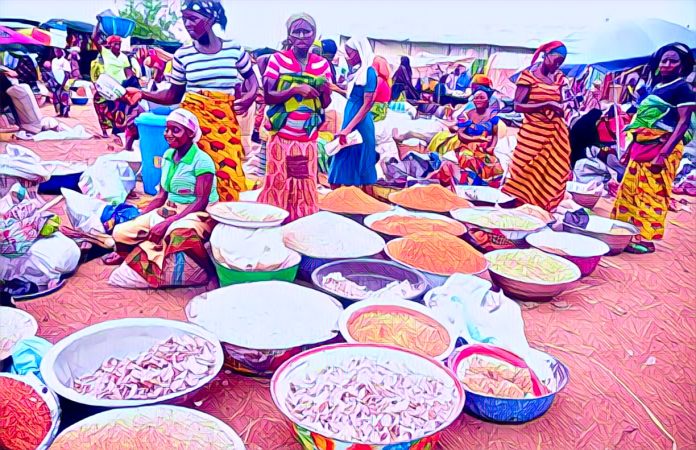
Nigeria’s 15 million market women move 70% of the nation’s food, generating $20 billion annually while operating Africa’s largest informal micro-credit system
-
They absorb climate, conflict, and inflation shocks through self-funded networks—stabilizing prices across West Africa despite zero institutional support
-
Facing market demolitions, tech disruption, and climate vulnerability, their survival hinges on policies recognizing their role as critical food security infrastructure
At 3:17 a.m., while Lagos sleeps, 62-year-old Mama Hadiza Danjuma hefts a 50-kg sack of onions onto her head, navigating pitch-black wharves where no forklift has ever roamed, as she attempts to navigate her way round Nigeria’s food security.
Her journey—like that of millions of Nigerian market women—begins in darkness and ends 14 hours later, having moved 15 tons of food from rural farms to urban plates across seven states.
This invisible supply chain, operated almost entirely by women, circulates $20 billion worth of produce annually, underpinning food security for 200 million Nigerians and neighboring nations.
Dubbed “agbado economists” (corn economists) for their mastery of grain arbitrage, these women execute feats logistics giants deem impossible: moving yams from Benue to Cameroon in 48 hours without refrigerated trucks, or stabilizing rice prices during floods by rerouting stocks via informal networks. “When bandits blocked highways to Niger State last harvest, we used canoe routes from Borgu,” reveals Hadiza, her ledger scribbled in code only her daughter can decipher. “No algorithm can calculate like a market mother’s intuition.”
The invisible backbone in Food Security: Risk absorption and micro-credit ecosystems
Beneath the vibrant chaos of markets like Mile 12 (Lagos) or Dawanau (Kano) lies a sophisticated financial architecture.
Each woman functions as a walking credit bureau—advancing seeds to farmers, underwriting losses from spoilage, and rotating capital through esusu (collective savings) pools. Research by Lagos Business School estimates these micro-credit flows at ₦7.8 trillion ($5.2 billion) yearly—triple the Central Bank’s agricultural lending.
Yet this system thrives on sacrifice. Hadiza’s profit margin per sack: ₦500 ($0.33). She absorbs shocks that would bankrupt corporations—from herder-farmer clashes destroying tomato shipments to petrol price hikes doubling transport costs. “We are the shock absorbers,” states Dr. Ngozi Okoro, food economist at Ibadan University. “When droughts hit Sahelian countries, it’s Nigerian market women who reroute sorghum from Sokoto to Chad—often before regional food agencies issue alerts.”
Innovation Born of Necessity
-
Preservation Alchemy: Using woven baskets lined with neem leaves to extend okra shelf life by 8 days
-
Data Networks: Price intelligence shared via coded prayer times (“Maghrib prices rise at Lokoja”)
-
Cross-Border Arbitrage: Exploiting currency gaps—e.g., buying Ghanaian cashews with naira, selling in CFA francs
Despite their indispensability, these women face existential threats. Lagos’s recent demolition of Owode Onirin market displaced 8,000 traders without compensation. Climate change slashes profit margins: “2023 floods ruined my onions—I repaid loans with my daughter’s dowry money,” whispers Hajiya Zainab from Kano. Tech startups promising to “disrupt” their trade ignore critical on-ground expertise; three agritech apps folded in 2024 after failing to map seasonal footpaths used by bean traders in Oyo.

