

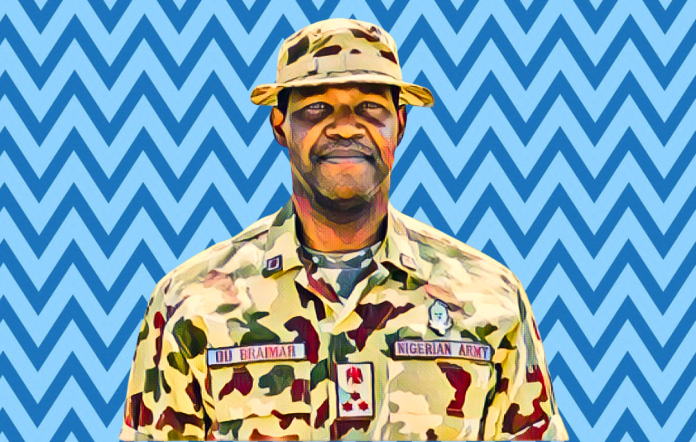
Key Points
- Braimah was on a midnight call with his UK twin when Boko Haram struck Benishiekh on April 9.
- The Edo-born general, buried April 15, held three postgraduate degrees and was days from a new posting.
- Edo governor approved full scholarships for Braimah’s three children; Borno governor donated N50 million to fallen troops’ families
The last sound Brigadier General Oseni Braimah’s twin brother heard from him was silence. The two men were on their usual late-night call when the terrorists came.
A family member, speaking on condition of anonymity, told how the Edo State-born general and his twin, an identical brother based in the United Kingdom, maintained a near-nightly phone ritual. That night of April 9, 2026, was supposed to be like the others. It was not.
“Braimah was a set of twins. His twin brother is not here in Nigeria. They are identical twins and are very close. They spoke almost every day,” the relative said.
“They started speaking after midnight, as usual, when, suddenly, the General paused, apparently because of some unusual movement at his end. After that, the line went dead.”
Unanswered calls in the dark
The identical twins shared a close bond and spoke almost every day, often around midnight. But that night the conversation took a tragic turn.
What followed was hours of a brother calling into a void. The twin dialed again and again, sent text messages, got nothing back. He stayed up through the night, calling until about 4 a.m., still hoping.
“By about 6:30am, I received a call from a senior Army officer. The moment I saw the call, I knew something was wrong,” the family member recounted. “He told me the situation at the Base was serious, before breaking the news.
The officer said the Base was under attack and communication had broken down. That was how I heard that some soldiers had been killed and that the Brigade Commander, my brother, was among them. It is heartbreaking.”
A career cut short at its peak
Braimah was on the verge of a transfer out of Borno to the Ministry of Defence when the attack occurred. He held a Bachelor of Arts in History from the Nigerian Defence Academy and three postgraduate degrees, including a Master’s in Defence Studies from King’s College London, a Master’s in International Relations and Strategic Studies from Benue State University, and a Master’s in National Security Management and War Studies from the National Defence University, Islamabad.
He had served as chief of staff at 6 Division Headquarters, Port Harcourt, as chief instructor at the Armed Forces Command and Staff College, Jaji, and as commander of the Infantry Presidential Guards Battalion in Abuja. He also served as a United Nations observer, contributing to ceasefire monitoring and intelligence support.
He was one of the soldiers killed on April 9 when suspected Boko Haram and the Islamic State West Africa Province members carried out coordinated attacks on military formations in Benishiekh, along the Maiduguri-Damaturu highway. He was buried with full military honors at the Maimalari Cantonment Cemetery in Maiduguri.
Edo governor steps in
Gov. Monday Okpebholo of Edo State has approved full educational scholarships covering three children of the late general, from their current school levels through university.
The beneficiaries are Farida Hussain-Braimah, 18, a 100-level Software Engineering student at Nile University, Abuja; Amir Hussain-Braimah, 16, currently in SS3 at Olumawu Senior School, Abuja; and Yasmeen Hussain-Braimah, 12, a JSS2 pupil at Olumawu Junior Secondary School, Abuja.
“Brigadier General Braimah paid the ultimate price in service to this country. It is only right that we stand by the family he left behind and ensure his children have uninterrupted access to education,” Okpebholo said.
Borno State Governor Babagana Umara Zulum separately announced a donation of N50 million to support the families of Braimah and seven other officers and soldiers killed in the attacks.
The Edo State government called on other state governments and private sector stakeholders to adopt similar support structures for families of military personnel who die in service.

