

KEY POINTS
- Olusegun Obasanjo said Charlie Boy’s tender care for his late father Justice Chukwudifu Oputa changed his initial dismissal of the entertainer.
- The former president called Charlie Boy’s memoir 999 a “masterpiece” and wrote its foreword.
- Obasanjo used the podcast interview to call for tolerance and warn against ethnic stereotyping.
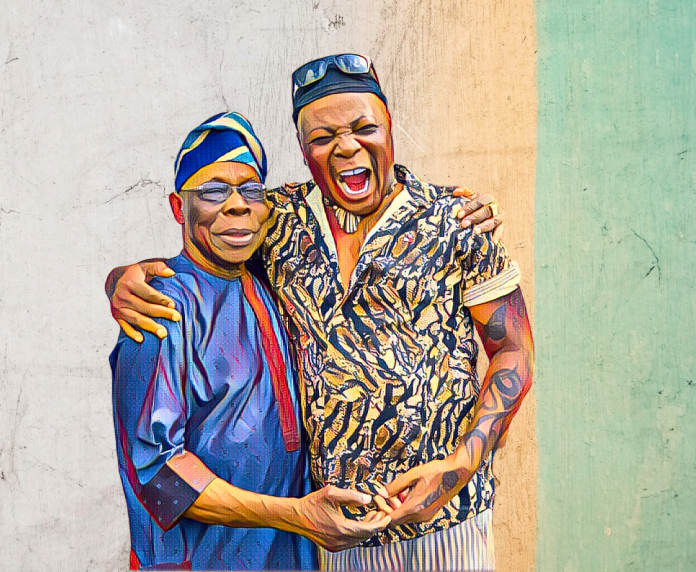
Former President Olusegun Obasanjo has admitted that he initially dismissed entertainer Charles “Charlie Boy” Oputa over his unconventional dress, before warming to him after watching him care for his aging father, the late Supreme Court Justice Chukwudifu Oputa.
Speaking on the Before Tomorrow Comes Podcast, posted on YouTube on Thursday, Obasanjo traced his shifting view of Charlie Boy across decades, framing it through the lens of his close friendship with Justice Oputa, one of Nigeria’s most respected jurists.
Now Obasanjo’s remarks land as the entertainer prepares to launch his memoir, 999, in Lagos in July. The former president, who wrote the book’s foreword, called it a “masterpiece” and “fairly well written, fairly well produced.”
From scorn to admiration
Specifically, Obasanjo said his first impression of Charlie Boy was unfavorable. The contrast with Justice Oputa, whom he described as “decent, well-groomed, well-dressed, immaculate, and proud,” was simply too sharp to accept.
“He was dressed jaga jaga. I said, ‘Look, how can an adult dress like this?’ So I didn’t think much of Charlie Boy,” Obasanjo recounted.
Indeed, that perception held for years. The former military head of state said he expected the son of a Supreme Court justice to mirror his father’s polish. The shift came, Obasanjo said, on a visit to see his old friend at Charlie Boy’s house. The scene caught him off guard.
“On one occasion, I wanted to pay him a visit. And where did I find him? I found him in Charlie Boy’s house. Of course, going into Charlie Boy’s house, you see him jaga jaga, living in his own house, on motorcycle, dressed like in war. But what struck me was Charlie Boy’s way of taking care of his father,” he said.
Moreover, Obasanjo said the entertainer’s devotion to his father trumped any concern about appearance. “If Charlie Boy had been ten times immaculately dressed, he would not have taken care of his father better than I saw him taking care of him.”
A second farewell from Charlie Boy
Today, Obasanjo says the same affection extended to Charlie Boy’s mother, whom he described as a “moral woman.” Additionally, he said Charlie Boy treated her with even greater devotion than his father, giving her “a decent goodbye that any child could give” when she died.
Furthermore, Obasanjo said the entertainer’s loud public persona is a calculated comedic act, not a contradiction of his character. “I realised that Charlie Boy’s jaga jaga tricks, his mediated acts of being a comedian and making money out of the way he dressed, his manner of behaviour, it’s all part of comedy, amusement,” he said.
Meanwhile, Obasanjo offered the Oputa family story as a parenting lesson. Justice Oputa, he said, accepted his son’s path away from law toward music and comedy, and grew to embrace the choice in his later years. However, the former president cautioned that parental tolerance has limits. He urged parents to guide children toward non-criminal paths that reflect their authentic identities.
Tolerance and unity
Obasanjo also used the interview to push back against ethnic generalizations in Nigerian public discourse. Together with the Charlie Boy reflections, his message landed as a broader plea for individual judgment.
“If you say the Yorubas are bad because of probably what one Yoruba man had done, or the Fulanis are bad because of what one Fulani man had done, then who’s good?” he asked.
Yet for now, the conversation around Charlie Boy will likely build through July, when 999 is presented in Lagos, with the former president’s endorsement carrying substantial weight on the launch.

