

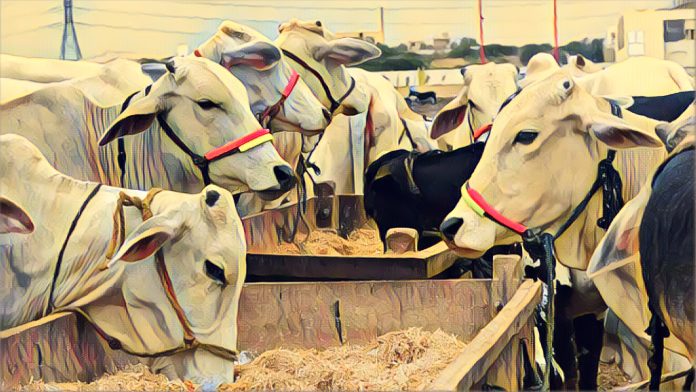
The Federal Ministry of Agriculture and Food Security (FMAFS) has reaffirmed its commitment to boost livestock production in Nigeria, a vital sector that employs 30 percent of the rural population and contributes to the country’s food and nutrition security.
The Permanent Secretary of the FMAFS, Dr. Ernest Umakhihe, made this statement at an event to distribute agricultural inputs and animal feeds by the ministry to flood-affected livestock farmers in the Federal Capital Territory (FCT).
He said the ministry would not relent in its efforts to work out interventions to address the plight of livestock farmers, who have been facing challenges such as climate change, high cost of feed, disease outbreaks, and insecurity.
He also said the ministry would up its ante to revitalize the agricultural sector, improve farmers’ livelihood, and enhance the country’s economic growth.
He pointed out that the distribution was aimed at cushioning the effect of climate change, increasing production, and reducing the importation of animal products.
He said: “The ministry will remain passionate when it comes to improving the productivity of the smallholder farmers who are mostly women and youth, we will continue to do everything in our capacity to encourage livestock production in the country.”
The FMAFS has been implementing various programs and policies to support the livestock sector, such as the National Livestock Transformation Plan (NLTP), the Livestock Productivity and Resilience Support Project (L-PRES), and the National Animal Identification and Traceability System (NAITS).
The NLTP, which was launched by President Muhammadu Buhari in 2023, is a comprehensive and holistic plan that aims to address the farmer-herder crisis, enhance livestock production, and create jobs and wealth.
The L-PRES, which is funded by the World Bank, is a six-year project that seeks to improve livestock productivity, resilience, and commercialization of selected value chains and to strengthen the country’s capacity to respond to an eligible crisis or emergency.
The NAITS, which is supported by the European Union, is a system that enables the identification, registration, and traceability of animals and animal products, thereby enhancing quality, safety, and market access.
The FMAFS also collaborates with other stakeholders, such as state governments, research institutes, the private sector, civil society, and development partners, to ensure the sustainability and effectiveness of its interventions.
The Mandate Secretary, Agriculture and Rural Secretariat, FCT, Mr. Kolo Geidam, who was represented by Mrs. Onyeji Edith, described the program as timely and commended the ministry’s commitment towards enhancing farmer’s income and livelihood.
He urged the beneficiaries to make good use of the inputs and feeds and to adopt best practices in their livestock management.
Earlier in her welcome address, the Director, of Animal Husbandry Services, Mrs. Winnie Lar Solarin, said that the event was an opportunity to share ideas, keep in touch with farmers, and acquaint them with modern technologies to improve their farming practices.
She also said that the ministry would continue to monitor and evaluate the impact of its interventions and solicit feedback from the farmers.
The event was attended by representatives of the FCT Administration, the World Bank, the European Union, the National Animal Production Research Institute (NAPRI), the National Veterinary Research Institute (NVRI), and the beneficiaries.
The livestock sector in Nigeria is one of the fastest growing in Africa, with a population of over 200 million cattle, sheep, goats, pigs, poultry, and other animals.
According to the National Bureau of Statistics, the sector contributed 2.29 percent to the Gross Domestic Product (GDP) in the third quarter of 2023, an increase from 1.65 percent in the first quarter of the same year.
The sector also has the potential to generate more revenue, create employment, reduce poverty, and enhance food security in the country.
However, the sector faces many challenges, such as low productivity, inadequate infrastructure, poor access to finance, and weak value chain development.
The FMAFS, through its various initiatives, is working to address these challenges and transform the livestock sector into a vibrant and profitable one for the benefit of the nation.
Source: ThisDay

