

KEY POINTS
- Wema Bank secured a €50m (N78.5bn) facility from EIB Global to support SMEs.
- At least 50 percent of the loans will target youth-owned enterprises.
- EU’s Global Gateway and Nigeria’s Financial Inclusion Strategy backed the deal.
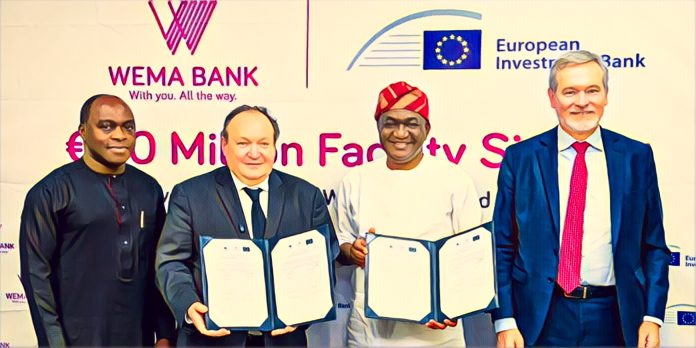
Wema Bank has secured a €50 million (N78.5 billion) financing facility from the European Investment Bank’s development arm, EIB Global, to expand access to credit for small and medium-sized enterprises, with a strong focus on women- and youth-owned businesses. The agreement, signed in Lagos, marks the first transaction between EIB Global and Wema Bank.
A deal built for inclusion
Under the arrangement, at least 50 percent of the loans will go to youth-owned enterprises, while the balance will support businesses owned, managed, employing or primarily serving women. According to EIB Global, the European Union’s Global Gateway programme backs the initiative, which also aligns with Nigeria’s Financial Inclusion Strategy.
Speaking at the signing, EIB Vice President Ambroise Fayolle framed the deal as a boost for jobs and equality. “This first financial agreement with Wema Bank is an important contribution to strengthen youth employment, gender equality and women’s empowerment in Nigeria,” he said. Moreover, he tied the partnership to climate goals. “We also support entrepreneurs in adopting best practices in green financing. This is our responsibility as the EU climate bank and a key partner of Global Gateway,” he added.
Support for green and growing businesses
Furthermore, EIB Global said it will provide technical assistance to Wema Bank under its Greening the Financial Sector Programme, in order to strengthen climate-related lending and promote sustainable investment. Consequently, the facility pairs fresh capital with capacity-building, so the lender can widen credit while it builds expertise in green finance.
Commenting on the deal, Wema Bank Managing Director and Chief Executive Moruf Oseni linked the agreement to the bank’s history. “As a bank whose legacy is rooted in empowerment, this agreement presents remarkable opportunities to scale our impact even further,” he said. In addition, he stressed the deal’s dual purpose. “This facility is strategically focused not only on helping more businesses access critical financial support, but also on addressing gender gaps and creating opportunities for Nigerian youths to become economically active and self-employed,” he said.
Ultimately, Oseni assured that qualified businesses, including participants in the bank’s entrepreneurship programmes, would benefit from the funding. By channeling the facility toward young and women entrepreneurs, both partners framed the agreement as a step toward deeper financial inclusion and a more inclusive, climate-conscious economy in Nigeria.

