

KEY POINTS
- Frozen accounts are still being investigated.
- CDS has been briefed repeatedly.
- Court apologises to defence lawyers.
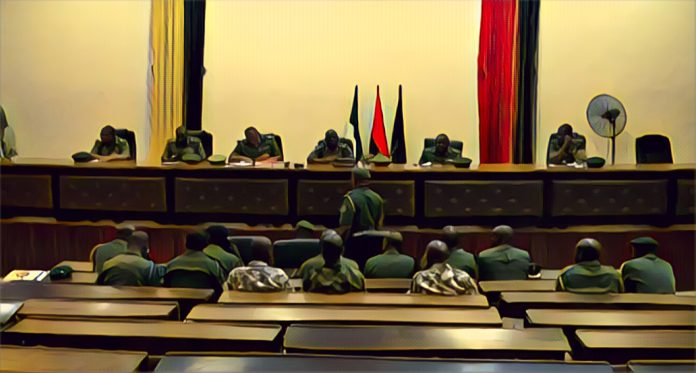
The General Court-Martial trying 36 Nigerian military personnel over an alleged plot to overthrow President Bola Tinubu’s government has said the bank accounts of some of the accused officers remain inaccessible because they are subject to ongoing investigations.
The President of the court, Air Vice Marshal H.I. Alhaji, made the disclosure while responding to complaints from defence lawyers about restrictions placed on the accused personnel’s bank accounts and other property.
He explained that military authorities could not directly intervene when accounts had been flagged by financial intelligence or anti-corruption agencies, noting that the Nigeria Financial Intelligence Unit (NFIU) and the Economic and Financial Crimes Commission (EFCC) do not report to the Chief of Defence Staff.
Alhaji said he had personally raised the issue of the affected accounts with the Chief of Defence Staff on more than six occasions. According to him, the CDS had been receptive to concerns raised by the military courts but was limited in dealing with matters under the control of other government agencies.
He said accounts that had not been returned to their owners were still being investigated and that military authorities could not simply order their release where the NFIU or EFCC had placed restrictions on them.
The disclosure followed concerns from lawyers representing the accused officers over their continued inability to access their funds and other property-related issues. The defence has also raised concerns about the treatment of the accused personnel and the circumstances surrounding the ongoing proceedings.
Alhaji said the concerns had been communicated to senior military authorities, adding that his most recent meeting with the Chief of Defence Staff partly addressed an issue raised by counsel representing Lieutenant-Colonel Hussein.
Court says its powers are limited
The court president also explained that although the General Court-Martial has the status of a High Court, its institutional powers differ from those of a conventional civilian High Court.
He said the court could make rulings but ultimately remained subject to the wider military command structure for certain matters. According to him, the Chief of Defence Staff had met with the military courts and considered their requests but could not directly control agencies outside his command.
Beyond the frozen bank accounts, Alhaji said discussions with the military leadership had covered the accused personnel’s properties, including vehicles and other items they allegedly brought into the country.
Issues concerning the movements and journeys of the accused officers were also discussed, as the court continued to address concerns raised by their legal representatives.
The court president also apologised to defence lawyers following tensions during an earlier sitting. He acknowledged concerns over the use of the phrase “I’m warning you” during the previous proceedings and said the choice of words would not be repeated.
Alhaji said the court recognised the important role of defence counsel and was making efforts to maintain a constructive relationship with the lawyers representing the accused personnel.

