

Former President Olusegun Obasanjo has backed calls to raise the 13% derivation paid to oil producing states, calling the current rate a starting point that can be negotiated upward.
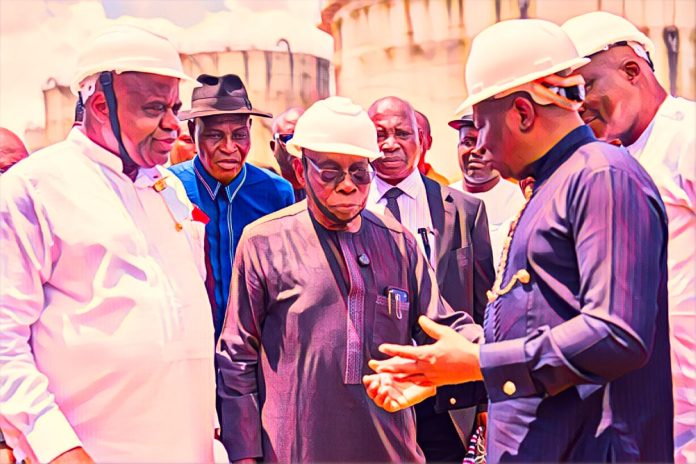
Obasanjo spoke Monday at Obunagha, near Yenagoa in Bayelsa State, at the inauguration of the crude distillation unit of the $1 billion Azikel Refinery. He told Gov. Douye Diri that states and oil bearing communities have not had a fair deal. “Thirteen percent is the beginning,” he said. “You can continue to talk.”
What Obasanjo said about the 13% derivation
The former president said the rate should be reviewed upward but also urged state governments to use current allocations carefully. He praised Diri for putting the money to use, pointing to projects across Bayelsa.
Diri went further. He called the 13% derivation inadequate and described the Land Use Act as unfair, because surface resources belong to states while what lies underneath belongs to the federal government. The people of the region, he said, deserve to be major players in the industry.
The refinery behind the remarks
Azikel Group President Azibapu Eruani said the refinery was conceived to move the Niger Delta from producing crude to refining it. Once complete, it is expected to produce 2.5 million liters of petrol and 2 million liters of diesel a day.
Obasanjo, who laid the foundation stone eight years ago, challenged Eruani to finish the plant within 12 months and said its capacity could later be doubled. Diri asked oil companies in the Gbarain and Obunagha area to repair the road leading to the site.
Azikel is one of several private refinery projects in Nigeria as the country tries to reduce fuel imports.
Why the derivation debate matters
Derivation is the share of natural resource revenue that goes back to the states where it is produced. The 1999 Constitution sets it at 13%, up from 3% before that, and the figure is paid from the federation account.
Obasanjo was president from 1999 to 2007, the period in which the 13% derivation took effect.
Raising the rate would need a constitutional amendment, which requires two thirds of both houses of the National Assembly and approval by at least 24 of the 36 state assemblies. Calls for an increase have surfaced repeatedly during past reviews. Any increase would also reduce the share left for other tiers of government.
Oil companies operating in the region face pressure. Under the Petroleum Industry Act, upstream operators must pay 3% of their annual operating spending into host community trusts, which critics say is too little.
Obasanjo’s message mixed pressure with a warning. Keep asking for more, he suggested, but spend what you already receive properly. Some residents and analysts have long questioned whether derivation money reaches communities.
Bayelsa has long been a center of Nigeria’s oil and gas production, and its leaders have repeatedly argued the region bears the environmental cost of the industry.
The 13% derivation is law for now. Whether it rises will be decided in the National Assembly, not at a refinery ceremony.

