

According to President Bola Tinubu’s pledge, the national minimum wage will soon be revised, which has several state governments in Nigeria extremely concerned about their finances. A report from the tripartite group that created the new pay framework was recently put on hold by the Federal Executive Council, signaling that further conversation between labor unions, representatives of the business sector, and federal and state politicians is necessary.
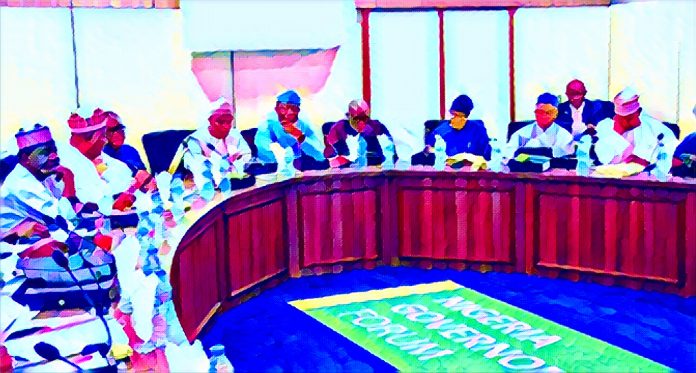
The implications of a potential wage rise were reviewed last week at meetings of the Southern Governors’ Forum and the National Economic Council. Given the disparities in state budgetary capacities, the governors’ conference emphasized the need for each state to bargain with its workforce regarding the minimum wage.
The Nigeria Governors’ Forum Secretariat released a paper titled “Analysis of State FAAC inflows and state expenditure profile,” which painted a bleak picture of the situation. It forewarned that a significant increase in ongoing expenses brought on by the proposed wage adjustment may force several states into bankruptcy. States with deficits in 2022 included Abia, Ekiti, Gombe, Imo, Katsina, Kogi, Oyo, Plateau, Sokoto, Yobe, and Zamfara. If ongoing expenses increase by 50%, thirteen more states may have financial difficulties, leaving only 10 in a stable financial condition.
The tripartite committee has proposed raising the minimum salary from the current N30,000 to N62,000, a significant rise. With their 2022 financial statistics taken into account, this modification would only leave states like Anambra, Bayelsa, Borno, Ebonyi, Gombe, Imo, Jigawa, Kaduna, Lagos, and Rivers with positive net revenues. Net revenue refers to the amount remaining after all recurrent expenditures are subtracted from total revenue—a positive figure indicates a surplus, whereas a negative one signals a deficit.
The total revenue for states comes from various sources, including the monthly Federal Account Allocation Committee disbursements, internally generated revenue (IGR), as well as aids, grants, and constituency development funds. For instance, Abia state, with 58,631 employees, faces a monthly wage bill of approximately N5.84 billion. Anambra pays around N1.82 billion in wages to its 20,541 employees, along with additional millions in pension obligations and debt servicing.
Bayelsa, with a workforce of 48,213, has a total monthly recurrent expenditure exceeding N10.53 billion, considering wages, pension obligations, and debt servicing costs. In contrast, Benue and Delta states show even more significant financial commitments due to their larger workforces and corresponding expenditures.
Financial data from 2022 reveal that Lagos state had the highest total revenue among the states, yet it also faced substantial recurrent expenditures. Similarly, other states like Kaduna, Rivers, and Ogun managed significant revenues but their financial stability is threatened by high ongoing costs.
The research also emphasizes how some states struggle with low IGR, which makes their financial problems worse. For example, the states of Kebbi and Zamfara had some of the lowest IGR numbers in 2022, which, when combined with heavy spending, presents a concerning economic picture.
Some states still have not raised their minimum wages to the 2019 level, despite federal pressure for a consistent increase in pay. The federation’s total staff expenditures rose by 13.44% in 2022, but state revenue surged by 28.95%, according to BudgIt 2023 report. States did not all enjoy this gain in revenue, though; 17 had a decrease in their IGR.
The labor unions, through voices like Chris Onyeka of the Nigeria Labour Congress, have accused many state governors of ignoring the Minimum Wage Act. Specific states such as Abia, Enugu, Bayelsa, and others have been pinpointed for failing to comply with the wage standards. Nonetheless, recent developments in states like Enugu show progress, with new commitments to fully implement the agreed minimum wage rates for all workers.
Given these monetary and administrative obstacles, the discussion surrounding the new minimum wage continues to provoke intense discussion and worry, highlighting the difficult balancing act between enhancing worker welfare and upholding financial responsibility in Nigeria’s diverse economic circumstances.

