

KEY POINTS
- Dangote says naira could strengthen to N1,100.
- Import reduction seen as key to stronger naira.
- Nigerian equities post 31 percent dollar returns in 2026.
Aliko Dangote said the naira could strengthen to N1,100 per dollar this year, citing government reforms and tighter controls on imports as key drivers of currency stability.
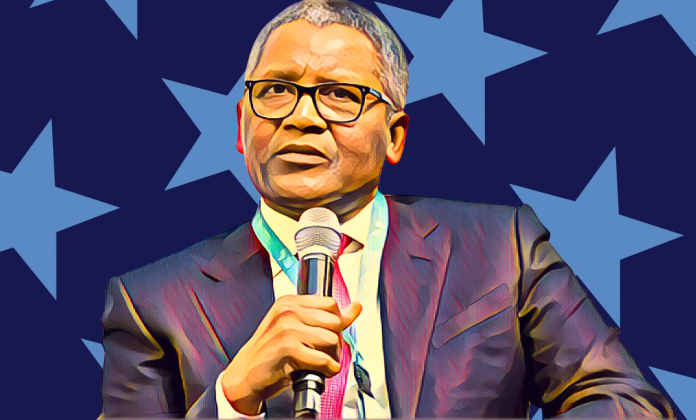
Speaking Tuesday at the launch of the Nigeria Industrial Policy in Abuja, the Dangote Group chairman told Vice President Kashim Shettima and other officials that recent policy measures were already yielding results for manufacturers.
Dangote Sees Stronger Naira Ahead
“Today, the dollar is N1,340,” Dangote said. “With what I know, by blocking all this importation, the currency this year will be as low as N1,100 if we are lucky.” The naira has recently traded around N1,300 to the dollar, strengthening to about N1,354 at the official market and between N1,430 and N1,440 on the parallel market, according to market participants.
Dangote argued that reducing reliance on imports would ease pressure on foreign exchange demand and support a stronger currency. However, he noted that an appreciating naira presents policy trade-offs.
“It’s a catch-22 situation,” he said, adding that a stronger currency could lower prices in an economy that remains heavily import-dependent. He urged policymakers to focus on expanding domestic manufacturing capacity.
The industrialist also called for greater protection for local investors, including improved infrastructure and more reliable power supply, to ensure that industrial policy translates into sustained production and job creation.
Market Gains and Refinery Impact
Dangote’s comments come as Nigerian equities post strong gains. Bloomberg reported that Nigerian stocks delivered the world’s second-best dollar returns in 2026, rising 31 percent and recovering $21 billion in market value lost after the naira’s sharp devaluation in 2024. Total market capitalisation on the Lagos Exchange further stands at about $84 billion, roughly 58 percent above pre-devaluation levels.
Billionaire investor Femi Otedola has also projected further currency appreciation, saying the naira could trade below N1,000 per dollar before the end of 2026.
Finally, he linked that outlook to the Dangote Petroleum Refinery reaching full capacity of 650,000 barrels per day and supplying up to 75 million litres of Premium Motor Spirit daily, a development he said would conserve foreign exchange.

