

Key Points
-
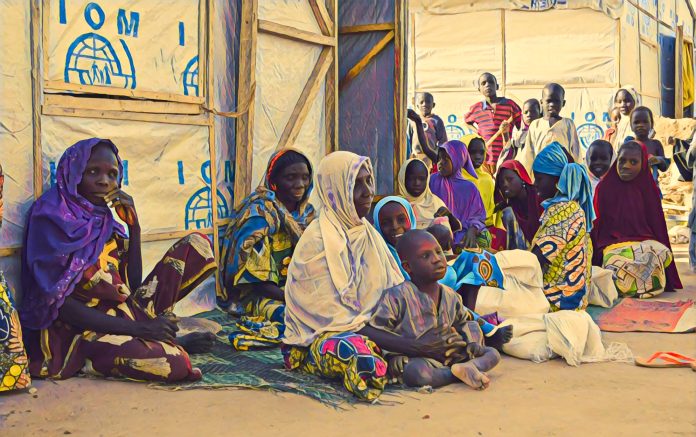
Insecurity has displaced about 3.7 million Nigerians living in nearly 3,900 camps and settlements nationwide.
-
Insurgency, banditry and farmer-herder clashes remain the main drivers of displacement.
-
Several states have begun resettlement efforts, but attacks continue to force new waves of displacement.
Nigeria’s long-running insecurity crisis has forced about 3.7 million people from their homes, with displaced families now scattered across nearly 3,900 camps and informal settlements across the country.
Data compiled from the International Organization for Migration’s Displacement Tracking Matrix, the National Bureau of Statistics, and humanitarian agencies show that 3,725,593 Nigerians are currently living as internally displaced persons (IDPs).
Officials say the figure is only an estimate because displacement patterns shift frequently as attacks continue.
Armed insurgency in the North-East, widespread banditry in the North-West, farmer-herder clashes in the North-Central, and communal conflicts in parts of the South have driven the crisis.
The scale of displacement has reached levels comparable to the population of some countries.
United Nations population estimates show that Nigeria’s displaced population is larger than the entire population of at least 63 countries, including Uruguay, Jamaica, Qatar, Namibia and Botswana.
Camps become permanent fixtures
Across many northern states, IDP camps have become a familiar feature of urban and rural landscapes.
What began as temporary shelters during the early years of the Boko Haram insurgency has gradually turned into long-term settlements for thousands of families.
Entire villages have been emptied after repeated raids by terrorists, bandits, cattle rustlers and kidnappers who attack communities, destroy farmland and abduct residents.
The result is a growing network of displacement camps and host communities struggling to support those forced to flee.
Mixed progress in resettlement efforts
Some states have attempted to reduce the number of camps by resettling displaced residents.
In Borno State, widely considered the epicentre of the Boko Haram insurgency, Governor Babagana Zulum has shut down several camps in recent years and encouraged residents to return home.
Only the Madinnatu camp in Jere Local Government Area remains operational.
However, violence continues to disrupt resettlement plans. A recent attack in Ngoshe community in Gwoza LGA displaced more than 3,000 residents and forced authorities to open a temporary camp near Pulka.
The assault also led to the abduction of more than 300 civilians, mostly women and children.
During a visit to the camp, Zulum said the government would provide food and establish cooking points to support displaced residents.
In Yobe State, authorities say all official camps have been closed after displaced residents returned to their communities.
States with the highest displacement
Several states still host large numbers of displaced people. Benue State currently shelters more than 500,000 IDPs, according to the International Organization for Migration, making it one of the worst affected areas.
The state operates 14 official camps while authorities plan permanent housing for thousands of families.
In Zamfara, persistent bandit attacks have displaced more than 276,000 residents. Officials say at least 107 villages have been overrun since 2009. Most displaced residents live outside formal camps in host communities.
Taraba State hosts around 90,000 displaced people across eight camps, while Sokoto State shelters more than 2,500 residents in the Ramen Kura camp after attacks in several local government areas.
In Plateau State, many displaced residents stay with relatives rather than in formal camps, a system that preserves community ties but places pressure on host families.
Government responses vary
State governments have adopted different strategies to manage displacement.
Some states, including Kebbi, say they have closed camps after security improved and residents returned home.
Others are shifting toward long-term solutions such as housing construction, farmland allocation and reintegration programmes.
In Benue, authorities have begun building permanent homes for displaced families and allocated 600 hectares of farmland to help them rebuild their livelihoods.
Despite these efforts, humanitarian workers say displacement remains fluid as insecurity persists in several regions.
Across Nigeria’s 36 states, displacement figures range from small clusters of hundreds to massive populations in the hundreds of thousands, reflecting the uneven impact of the country’s security challenges.
For many displaced families, the hope of returning home depends on one thing: a sustained improvement in security.

