

KEY POINTS
- Nigeria graduated 744 former Boko Haram fighters from Operation Safe Corridor, drawing immediate fury from victims, lawyers and community leaders.
- A lawyer pledged to seek a federal court order halting the programme, calling it legally fraudulent and an insult to terrorism victims still in IDP camps.
- A serving major general, speaking anonymously, warned that some graduates are intelligence plants and that senior officers sympathize with the insurgents.
A lawyer has threatened to go to court. A retired admiral called it strategic naivety. A Kano businesswoman who lost six relatives to Boko Haram said nobody is talking about the victims. And a serving major general, speaking anonymously, said some senior officers sympathize with the insurgents.
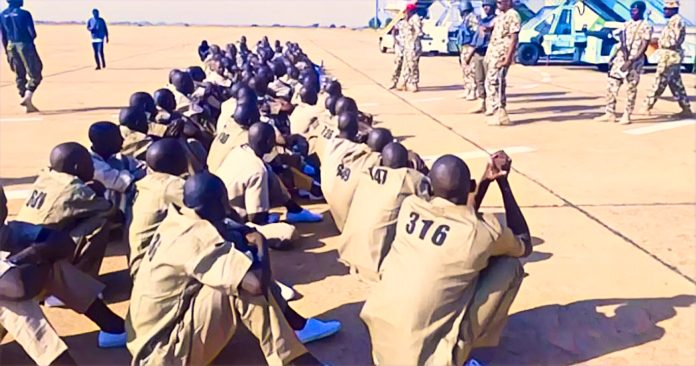
The Federal Government’s graduation of 744 former terrorists from the Operation Safe Corridor de-radicalisation camp in Gombe has triggered a wave of anger across Nigeria, with critics from nearly every part of the country questioning whether the programme rewards violence, endangers communities and abandons the people who suffered most.
What the government said
Chief of Defence Staff Gen. Olufemi Oluyede, speaking at the graduation, described the programme as a strategic intervention rather than a concession to insurgents, arguing that sustainable peace depends on rehabilitation alongside military operations.
He stressed that it is not an amnesty and urged the graduates not to return to violence. “Nigeria is giving you a second chance; do not waste it,” he said.
Of the 744 graduates, 597 came from Borno State, with the rest drawn from Yobe, Adamawa, Kano, Bauchi and other states. Eight foreign nationals from Burkina Faso, Cameroon, Chad and Niger Republic were also among the cohort. Participants underwent 24 weeks of psychosocial therapy, vocational training, religious reorientation and civic education.
Retired admiral: this is disengagement, not de-radicalisation
Rear Admiral Dickson Olisemelogor, a retired naval officer, drew a sharp distinction between the two concepts. “The boys are pulled out of their groups and given some soft landing by engaging them in various government agencies without addressing the causes of their anger. To me this is a big mistake,” he said.
He warned the programme is being used by some participants as a cover: “Some are purposely sent to gather intelligence and infiltrate security agencies. This is the reason they return to their old group or even form a new terror group once they have the opportunity.”
A lawyer going to court
Legal practitioner Dr. Maxwell Opara announced on television that he would seek a federal court order to halt the programme, describing the release of 744 former insurgents as “an epitome of fraud.” He argued that Nigerian law requires investigation, prosecution and conviction before any form of rehabilitation is applicable.
“I have a client that mistakenly murdered somebody through a fight. That young woman has spent over 25 years, as I speak to you now, at Suleja Prison.
And then, there is somebody who sacked an entire community in the name of terrorism and after six months, they told us that they had repented and are going to be reintegrated into society,” Opara said.
He also challenged military authorities to prove the programme has worked. “Since you applied this particular procedure in Nigeria, tell us the rate of terrorism when you started it and the rate of terrorism now.”
Victims invisible, critics say
Aminat Saudi, a Kano businesswoman who said six of her relatives were killed by terrorists in Borno, asked the question many others raised. “What happens to the families of those killed by the repentant terrorists? Who refunds the ransom paid by victims of these so-called repentant terrorists?”
The Federal Government has consistently defended the programme as pragmatic, arguing that not all participants were ideologically committed fighters, with many reportedly conscripted under duress. Authorities say participants are screened before admission and that post-reintegration monitoring is built into the process.
That argument did not satisfy the Middle Belt Forum. National president Dr. Bitrus Pogu said: “Anybody who treats insurgents the way our government is treating them can be seen and labeled as sponsors and supporters of insurgency.”
The Northern Youth Council and the Benue State tribal leaders echoed similar sentiments, with Mzough U Tiv chairman Chief Iorbee Ihagh calling the programme “a policy that tends to mock those that have been dealt with.”
A serving general speaks
One of the most striking voices came from a serving major general who asked not to be named. “Some people don’t even understand the ideology, they just have a soft spot for Boko Haram. To be candid, we even have senior officers who sympathise with them. They have infiltrated the system,” he said.
He added a broader critique: “I have served as defence attaché in many countries, and I have come back to realise that Nigeria is not a nation. We are just a group of people thrown together, coexisting.”

