

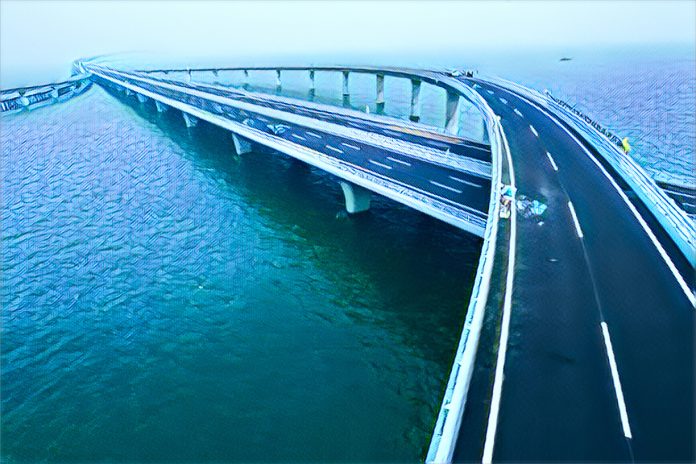
Lagos, Nigeria’s commercial capital, is set to construct a 38-kilometer-long bridge that will connect the mainland and the island parts of the city. The bridge, known as the Fourth Mainland Bridge, will be the second longest in Africa, after the 6th October Bridge in Cairo, Egypt.
The bridge project, estimated to cost $2.5 billion, is a public-private partnership (PPP) between the Lagos State Government and a group of private investors led by the Chinese construction company CCECC-CRCCIG Consortium. The consortium was selected as the preferred bidder for the project on December 29, 2022, after a competitive bidding process that involved 15 other applicants.
The bridge will feature four lanes, providing a bus rapid transit (BRT) lane and future road expansion. It will also have three toll plazas, nine interchanges, a 4.5-kilometre lagoon bridge, and an eco-friendly environment. The bridge will have a design speed of 120 kilometers per hour and a generous median for light rail development.
The bridge will start from Abraham Adesanya in Ajah, on the Eti-Osa-Lekki-Epe corridor and traverse the northwest towards the lagoon shoreline of the Lagos-Ibadan Expressway via Owutu/Isawo in Ikorodu. It will then cross the Itoikin Road and the Ikorodu-Sagamu Road to connect the Isawo inward Lagos-Ibadan Expressway at the Ojodu Berger axis. The bridge will align with eight major roads, including the Lagos-Ibadan Expressway, the Lagos-Abuja Highway, the Benin-Sagamu Road, and the Igbogbo-Lagos Road.
The bridge is expected to ease the traffic congestion on the existing Carter, Eko, and Third Mainland Bridges, which are often overstretched by the growing population and vehicular movement in Lagos. It will also open up new areas of the city for future development and enhance the socio-economic activities of the residents.
The Lagos State Government has announced that the bridge will be completed by 2027 and that the turning of the sod for the project will be done in the first quarter of 2023. The project will be financed through debt and equity, with the state government providing 25 percent of the equity, while the private investors will provide the remaining 75 percent. The bridge will be operated as a tolled facility for 25 years, after which it will be transferred to the state government.
The Fourth Mainland Bridge project is part of the Lagos State Government’s vision to transform the city into a smart, resilient, and sustainable megacity that can compete with other global cities. The project is also in line with the federal government’s plan to improve the infrastructure and connectivity in the country.
The project has received the approval of the Federal Ministry of Environment, which granted a no-objection certificate for the environmental and social impact assessment (ESIA) report of the project. The report was subjected to a public display and consultation that also included the resettlement policy framework for the project.
The project stakeholders, including the Ministries, Departments, and Agencies (MDAs) of the state government, have also reviewed the legal advisers’ report and the draft concession agreement for the project. They have expressed their commitment to ensuring the sustainability, openness, and accountability of the project.
The Fourth Mainland Bridge project is a landmark achievement for Lagos and Nigeria, as it will not only enhance the mobility and livability of the city but also create employment opportunities, boost the tourism sector, and stimulate the economic growth of the state and the nation.
Source: Business Day

