

Key Points
- 14.3 million Nigerians aged 15-64 used illicit substances in a single year, a prevalence rate nearly three times the global average.
- Existing rehabilitation centers can accommodate less than 10 percent of the estimated 2 million Nigerians who need treatment for substance use disorders.
- NDLEA made 3,913 arrests and seized over 113,000 kilograms of drugs in just the first two months of 2026 alone.
Nigeria is staring down what public health officials are now calling a full national emergency. In the space of a single year, 14.3 million Nigerians between the ages of 15 and 64 used illicit substances, a prevalence rate of 14.4 percent that is nearly three times the global average, according to the National Drug Law Enforcement Agency’s last comprehensive national survey.
The numbers are staggering. The human cost behind them is worse.
A generation at risk
Femi Babafemi, director of media and advocacy at NDLEA, said the scale and speed of the problem demand urgent, nationwide action. “The scale of abuse is far beyond isolated cases,” he told Saturday Vanguard.
Youth aged 25 to 39 account for the majority of active users, a fact Babafemi described as a direct threat to Nigeria’s workforce and long-term development.
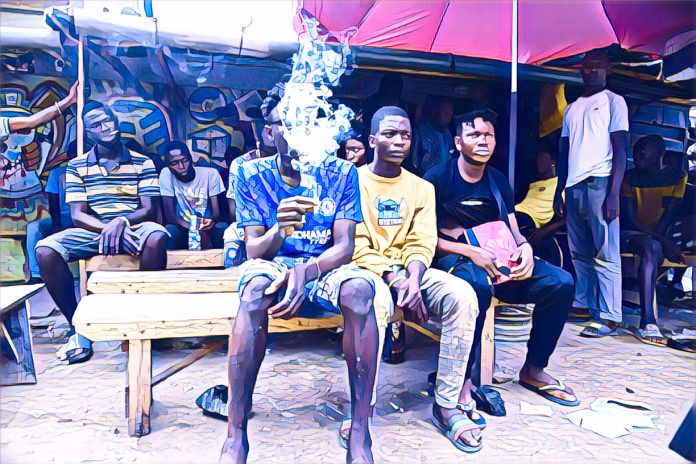
On street corners, in university hostels and in rural neighborhoods, cheap drugs have become part of daily survival. Tramadol tablets sell in strips of 10 for as little as 500 naira. Flavored codeine syrup goes for under 1,000 naira, less than a loaf of bread in many Nigerian markets. In Lagos and Port Harcourt, cannabis, tramadol and codeine dominate.
In Abuja, Rohypnol and diazepam circulate widely. In rural communities, petrol fumes, glue and paint thinners fill the gap where pharmaceutical drugs are harder to come by.
What happens when it reaches the hospitals
At the Neuro-Psychiatric Hospital in Aro, Abeokuta, Dr. Ayantunde Ayankola, a senior consultant addiction psychiatrist, said roughly 75 percent of patients present with drug-related problems, whether dependence or co-occurring mental health conditions. One in four users is female, but only one in 20 seeks treatment.
“Stopping drugs is only one aspect,” Ayankola said. “True recovery means regaining life and functioning.” He warned that addiction, like hypertension, is treatable but not curable, and that without strong family and community structures, relapse rates remain high.
Addictologist Martin Awogie put the picture in even starker terms. He said recent community-level studies suggest the actual number of users may have climbed to one in five, or even one in four Nigerians.
Out of the millions using, over 2 million suffer from disorders requiring professional care. Existing rehabilitation facilities can accommodate less than 10 percent of that number. Trained addiction specialists are in short supply nationwide.
Supply chains and enforcement
NAFDAC director-general Prof. Christianah Adeyeye said the regulatory framework looks strong on paper but breaks down at the last mile. “The greatest vulnerabilities remain in informal distribution networks, post-import diversion, smuggling and weak last-mile control,” she said.
A crackdown on open drug markets in Onitsha, Aba and Lagos resulted in seizures valued at roughly 1 trillion naira, the largest in NAFDAC’s history.
NDLEA’s enforcement numbers tell their own story. Between January and February 2026, the agency recorded 3,913 arrests, 581 convictions and over 113,000 kilograms of drug seizures. Over the past five years, the total stands at 77,859 arrests, 40,122 convictions and nearly 15 million kilograms of seized substances.
The human face of recovery
Abdulmalik Yahaya was 15 when a friend handed him his first bottle of codeine. What followed was years of spiraling use, codeine, Rohypnol, shisha, cannabis, a broken family, skipped classes and a near-complete disappearance from his own life. His turning point came after a cannabis episode that triggered hallucinations so intense his family forced a hospital intervention.
Today, three years sober, he writes poetry. “Addiction may bury your purpose for a while,” he said. “But it can never erase it.”
Aggie Ekanem-Uwem, a nurse who became dependent on Pentazocine after a misdiagnosis and emergency surgery, chose recovery on New Year’s Eve 2018. She went on to complete her university education and now counsels others.
What experts say must happen next
Both Awogie and Babafemi agree that enforcement alone will not break this crisis. Babafemi said NDLEA operates 30 treatment and counseling centers nationwide, with a 24-hour toll-free helpline staffed by mental health professionals. Proposed amendments to Nigeria’s drug laws would impose jail terms of up to 25 years for traffickers.
But the infrastructure is nowhere close to the scale of need. Awogie noted that all major prevention programs in Lagos and Ogun states were funded entirely by international donors, with no domestic government contribution. “This is our problem, and we must address it,” he said.
Without decisive policy, expanded funding and a whole-of-society commitment from families, schools and religious institutions, experts warn that Nigeria is not managing a drug problem. It is watching one generation disappear.

