

KEY POINTS
- Aliko Dangote rejected NNPC’s bid to raise its 7.25 percent stake in the Dangote Refinery, saying the company is preparing a public listing.
- The Lekki refinery is producing at 661,000 barrels per day, above its 650,000 bpd nameplate, and plans to double to 1.4 million bpd within 30 months.
- Dangote is targeting $100 billion revenue and over $30 billion EBITDA by 2030, with $45 billion in capital injection planned.
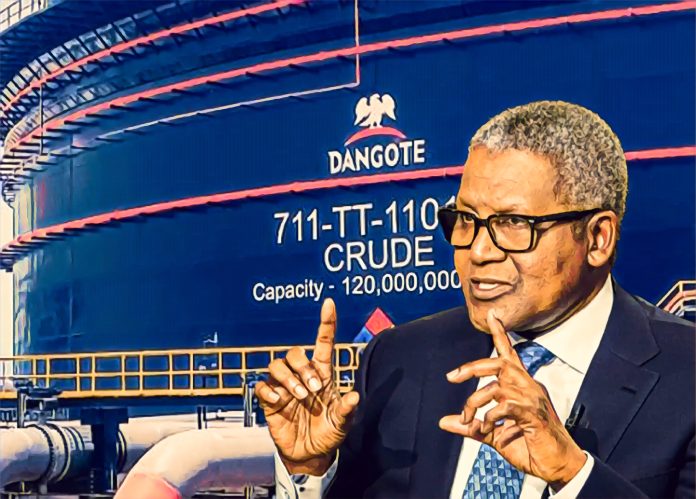
Aliko Dangote on Wednesday said the Dangote Group rejected the Nigerian National Petroleum Company Limited’s bid to raise its 7.25 percent stake in the $20 billion Lekki refinery, telling Norwegian Sovereign Wealth Fund chief executive officer Nicolai Tangen that the plant is heading for a public listing that will open shareholding to ordinary Nigerians.
The disclosure marks the clearest signal yet that Africa’s richest man intends to take the refinery public, an exit strategy that would let domestic investors share in a plant already operating at 661,000 barrels per day, above its 650,000 bpd nameplate capacity.
Now the rejection of NNPC’s request reframes Nigeria’s downstream conversation, with Dangote positioning his refinery as a private-sector asset whose ownership belongs to the Nigerian investing public rather than the state oil company.
Stake rejected, listing ahead
Specifically, Dangote said NNPC, which acquired its 7.25 percent stake for $1 billion in 2021, had pushed to buy more equity. The original agreement covered a 20 percent stake, but the national oil company reneged on the balance and ended up paying for only 7.25 percent by the June 2024 deadline.
“The national oil company already owns 7.25 percent, and they are trying to buy more. We are the ones that said no; we want to now spread it and have everybody be part of it,” Dangote said.
Indeed, the listing pitch comes with a dividend hook. Dangote said shareholders investing in his cement, refinery, petrochemicals and fertilizer businesses will receive dollar dividends because 80 percent of group revenue will be in dollars.
Refinery flexes capacity
Moreover, the refinery is now running above nameplate. Dangote said the plant has processed crude at 661,000 barrels per day, a performance he said gives global financial institutions confidence to back the next phase of expansion.
Furthermore, the group sources roughly 56 percent of its crude from Nigeria and supplements with cargoes from Angola, Libya and the United States, lifting 21 cargoes a month. Dangote said the refinery will more than double to 1.4 million barrels per day within 30 months, a build that would reshape global refining geography.
Additionally, the US-Iran conflict has supercharged demand for the refinery’s output. The refinery has presold aviation fuel through mid-July, with the plant producing 20 million litres of jet fuel a day, while fertilizer prices have climbed from $400 to $850 per tonne and polypropylene from $900 to about $3,000.
The $100 billion vision
Meanwhile, Dangote sketched out a 2030 plan anchored on $45 billion in fresh capital, partly raised through asset sales and new investors, that aims to lift group revenue to $100 billion and EBITDA to more than $30 billion against the $3 billion EBITDA recorded last year. The target market valuation sits above $250 billion.
However, Dangote flagged risks. He named civil war as a tail risk and government policy inconsistency as a present-day drag, while pointing to what he called a “Mafia” of subsidy-era beneficiaries, shippers, traders and politically connected importers trying to undermine the refinery.
Together, the listing plan, the 1.4 million bpd expansion target and the global windfalls from the Middle East crisis position Dangote at the intersection of Nigeria’s energy security and forex earnings agenda. Q1 2026 data showed local petrol supply rose 59.2 percent year-on-year to 3.18 billion litres while imports fell 60.2 percent to 965.52 million litres.
Whether the public listing lands at a valuation that vindicates Dangote’s $100 billion 2030 horizon will depend on capital markets, naira stability and how quickly the 1.4 million bpd expansion comes online. Yet for now, the message to NNPC and to Nigerian investors is clear: the refinery’s next ownership chapter belongs to the public.

