

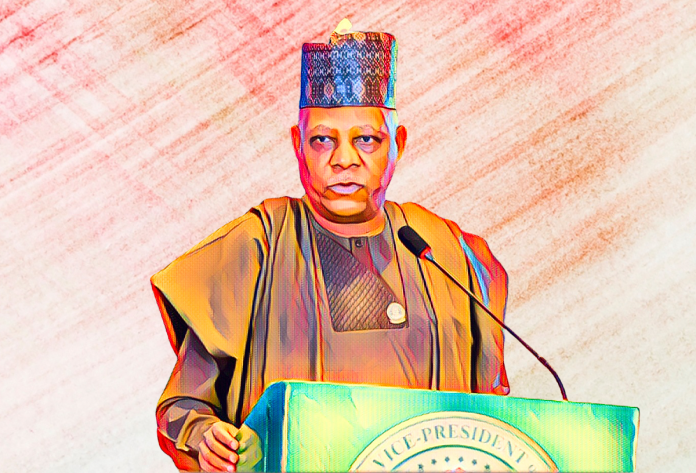
Vice President Kashim Shettima has told state governments to stop waiting for the federal government to fix their power problems and to build state electricity markets of their own under the Electricity Act 2023.
He made the call Wednesday at the opening of the National Stakeholders’ Workshop on the Electricity Act 2023, held at the State House in Abuja. He was represented by Ibrahim Hadejia, the deputy chief of staff to the president.
What the vice president told states
Shettima said the Act lets states develop and regulate electricity markets within their borders, subject to the constitution and other laws, and that Nigeria’s diversity calls for that kind of decentralization.
He said Nigeria’s goal of building a competitive industrial economy will remain limited unless electricity reforms deliver reliable power to businesses, households and public institutions.
The law alone will not improve supply, he warned, and states that have not yet created electricity regulators should begin their legislative and institutional preparations without delay.
Resources states can build on
Shettima pointed to the energy resources spread across the country: solar potential in Sokoto, Borno and Katsina, gas in Delta, Rivers and Bayelsa, and hydropower in Niger and Kebbi. He urged states to use them to attract private investment.
To speed up reform, he proposed a voluntary National Electricity Reform Peer Review and Implementation Framework. It would bring together the Nigerian Electricity Regulatory Commission, the power ministry, the Nigeria Governors’ Forum and state regulators to share experience and track progress.
The framework would help states strengthen their regulators and measure progress on market development, investment readiness, consumer protection and access to power, he said, and let them avoid mistakes others have already made.
What the power ministry added
Mahmuda Mamman, the ministry’s permanent secretary, represented the minister and said the success of the Electricity Act depends on states creating credible institutions and commercially viable electricity markets.
That is the hard part. A state regulator needs funds, staff and independence, and a state market needs buyers who pay, which has long been a weak point in Nigeria’s electricity sector.
Recent figures show the scale of the challenge. Nigeria’s distribution companies collected N603.64 billion in the second quarter, but total losses stood at 36.23%, according to the national regulator.
Some states have already moved. Lagos, for example, is piloting 24 hour power zones with the federal government, which says the Lagos corridor accounts for 40% to 50% of national demand.
At least one outlet framed the remarks as an attempt to shift blame for persistent power shortages. Reports of the workshop did not say how the federal government would help states that lack money or expertise.
The proposed peer review is voluntary, so it carries no penalty for states that ignore it.
Shettima’s message is that Abuja alone cannot light every state. If states build regulators that investors trust, and markets that collect what they bill, power could improve where it matters most, in homes, shops and factories. If they do not, the Act will remain a promise on paper.