

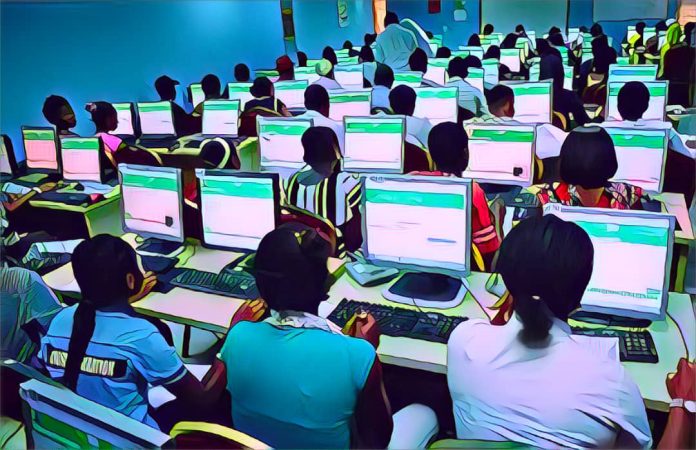
The West African Senior School Certificate Examinations (WASSCE) are a crucial test for Nigerian students who want to pursue higher education. But many of them may not pass the exams this year, due to a controversial change in the format.
The West African Examinations Council (WAEC), the body that administers the WASSCE, has decided to switch from the traditional pen-and-paper mode to a computer-based test (CBT) mode. This means that students will have to answer questions on a computer screen, instead of writing them on paper.
The WAEC stated that the CBT mode is more efficient, secure, and environmentally friendly. It also claimed that it will reduce malpractice and cheating, which are rampant in the WASSCE.
However, not everyone agrees with this decision. The Arewa Youth Consultative Forum (AYCF), a group that represents the interests of northern Nigerian youths, has called for the cancellation of the CBT mode. Based on a report by Punch, it argued that the CBT mode will disadvantage students from rural areas, especially in the north, where computer skills are scarce or nonexistent.
A Digital Divide
The AYCF stated that the CBT mode will create a digital divide between the rich and the poor, the urban and the rural, and the north and the south. It said that many public schools in the north lack the facilities, equipment, and internet access to prepare students for the CBT mode. It also mentioned that many students have never used a computer before, and will struggle to adapt to the new format.
The AYCF cited research that it conducted in selected northern states, such as Zamfara, Jigawa, Taraba, Adamawa, Nasarawa, and Plateau. It stated that the CBT mode has led to misleading failure rates among students attending public schools, where computer skills are often not taught.
AYCF also pointed out that the CBT mode has caused problems for students who took the Joint Admissions and Matriculation Board (JAMB) exams, which are similar to the WASSCE. It said that many students who failed the CBT-based JAMB exams last year blamed their failures on systemic failures, such as insufficient facilities, network failures, outdated computers, and lack of computer skills.
The AYCF said that the CBT mode should have been optional, allowing students to choose between the pen-and-paper mode and the computer-based mode. It stated that this would have given students a fair and equal opportunity to succeed, regardless of their background, location, or resources.
A Call for Action
The AYCF has urged the WAEC to reconsider its decision and revert to the pen-and-paper mode for the WASSCE. It has also appealed to the federal government, the National Assembly, the Ministry of Education, and other stakeholders to intervene and protect the interests of the students.
The AYCF said that the WASSCE is a vital exam that determines the future of millions of Nigerian youths.
The WAEC has not responded to the AYCF’s call yet. The WASSCE is scheduled to take place in March 2023, and more than 1.5 million students are expected to sit for it.
Despite the challenges and uncertainties, some students are hopeful that the CBT mode will bring positive changes to the education system. They said that the CBT mode will prepare them for the digital age, and make them more competitive and employable.
They also stated that the CBT mode will improve the quality and credibility of the WASSCE, and reduce the cases of fraud and corruption.

