

KEY POINTS
- NSIA systems-building strategy now defines Nigeria’s sovereign fund.
- NSIA systems-building strategy spans healthcare, energy and innovation.
- The approach blends financial returns with structural reform.
More than a decade after its creation, the Nigeria Sovereign Investment Authority has moved well beyond its original remit as a fiscal buffer and long-term savings vehicle.
The fund, established by law to stabilise public finances and invest for future generations, is increasingly positioning itself as a national systems builder deploying capital, partnerships and institutional discipline to address deep-rooted constraints on growth.
As NSIA adds additional development assets to its portfolio, that evolution is becoming clearer. At the same time, NSIA’s reputation for governance is among the best in the world. The authority got a perfect score on the Global SWF Governance, Sustainability, and Resilience Index in 2025 and kept its 9 out of 10 rating on the Linaburg-Maduell Transparency Index. This solidified its reputation as one of the most responsible sovereign investors in the world.
How NSIA systems-building strategy is taking shape
This change has been supported by financial momentum. By June 2025, NSIA’s net assets had grown to more than $3 billion for the first time, thanks to government funding and profits that were kept. Core total comprehensive income rose 6 percent year on year to ₦202.1 billion in the first half, while assets have grown from $1 billion at inception to $3.1 billion, a compound annual growth rate of 9.9 percent across multiple economic cycles.
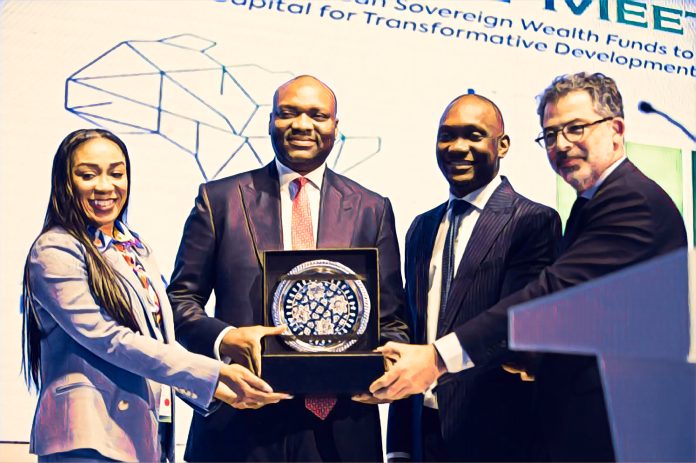
Under Managing Director and Chief Executive Aminu Umar-Sadiq, NSIA has leaned into sectors where capital alone is insufficient without execution capability. In the field of innovation, it worked with the Japan International Cooperation Agency to launch the $28 million Impact Innovation Fund, which helps early-stage tech businesses that are working to solve social problems. The NSIA Prize for Innovation underpins the fund and has attracted more than 5,000 applications nationwide while awarding over $250,000 to young founders.
Healthcare has become another cornerstone. Through its subsidiary MedServe, NSIA is upgrading oncology and nuclear medicine facilities across six tertiary hospitals in partnership with the Federal Ministry of Health. Authorities commissioned three centres in 2025, and patients are already receiving treatment, alongside a $2 million national oncology training programme for 500 clinicians.
Energy investments have followed a similar model
The Renewable Investment Platform for Limitless Energy and the new Distributed. The Renewable Energy Fund aims to attract private investment for both grid and off-grid power. They are based on the 10-megawatt Kano Solar project. Agriculture, housing, and credit markets have also been important. For example, the Presidential Fertilizer Initiative helped increase fertilizer production, and the government has also supported affordable housing and developed credit guarantee platforms that make it easier for people to get loans.
Together, these efforts reflect a deliberate strategy: pairing financial returns with institutional fixes. As 2025 draws to a close, NSIA’s leadership argues that the true measure of performance lies beyond balance sheets in systems that endure, markets that deepen and opportunities that multiply.

