

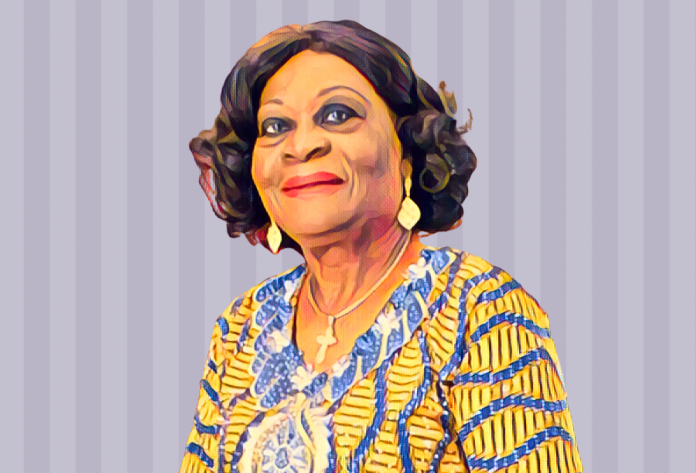
KEY POINTS
- Former Lagos Deputy Governor Kofoworola Bucknor-Akerele warned that APC’s bid to absorb opposition parties and form a one-party state will fail.
- She described Nigeria’s current climate as “dangerous,” citing insurgency pressures and an economy where many cannot afford one meal a day.
- Bucknor-Akerele said she resigned as Tinubu’s deputy in 2002 because she refused to help him take over the Alliance for Democracy.
Former Lagos Deputy Governor Kofoworola Bucknor-Akerele on Friday warned that the All Progressives Congress’s drive to absorb opposition parties and herd Nigeria into a one-party state ahead of 2027 will not work, calling the political climate under President Bola Tinubu “dangerous.”
Speaking on Vanguard’s political show Politics Hub, the veteran politician said the ruling party is hollowing out the opposition through defections and infiltration even as Nigerians grapple with food prices and security pressures her camp regards as a national emergency.
Now her remarks add a senior Lagos voice to the swelling chorus of opposition figures arguing that the APC is using federal incumbency to corner the political space ahead of the next election cycle.
A ‘dangerous’ climate
Specifically, Bucknor-Akerele said two threats run in parallel: a security situation she described as Nigeria being “swamped by insurgents,” and an economy in which many households cannot afford a single meal a day.
“We are in a very dangerous political climate at the moment, we are in danger of being swamped by insurgents and then, we are also in danger of being lost economically because the economic situation is really disastrous,” she said. “Most people are finding it difficult to be able to eat one square meal a day and this is a tragic situation for us to be in.”
Indeed, her framing aligns with opposition critiques that the Tinubu administration’s reform program has weighed heavily on consumer purchasing power without yet delivering visible relief.
One-party drift
Moreover, Bucknor-Akerele accused the APC of running a deliberate campaign to weaken every other platform on the ballot. She said the goal is to corner political competition rather than win it on merit.
“Look at what is happening to all the political parties. The main party is trying to infiltrate all the political parties and turn Nigeria into a one-party state and I do not think it can work,” she said. However, she stopped short of detailing specific cases beyond the general defection wave that has carried lawmakers, governors and party chieftains across the aisle in recent months.
Today, Bucknor-Akerele’s perspective carries weight precisely because she once sat beside Tinubu in office. She served as deputy governor of Lagos from May 1999 to December 2002, when she resigned after political disagreements that she described as fundamental. According to Bucknor-Akerele, the rupture stemmed from a clash over the Alliance for Democracy and Tinubu’s plans for the party.
“Bola Ahmed Tinubu did not want to work with me at all because he had a different agenda to the agenda of what the AD stood for at that time. What he wanted was somebody who would assist him in taking over the AD and because I was not ready to do that, we had our differences,” she said.
Power for what?
Furthermore, Bucknor-Akerele drew a line between politicians she said use power to serve and those who seek what she called self-aggrandizement.
“I think some people go into power for self-aggrandizement, while others go into power because they want to serve and I think that was the difference between me and the powers that be, let us put it that way,” she added.
Meanwhile, the APC has rejected similar charges in recent weeks, framing the wave of defections as voluntary realignments by politicians who see the ruling party as the most credible vehicle ahead of 2027. Together, the competing narratives will shape the early scripts of the upcoming campaign.
Whether Bucknor-Akerele’s warning resonates beyond opposition circles will depend on whether Nigerians decide the economic and security pressures are reason enough to recalibrate the political map. Yet for now, her message lands as the latest signal that Tinubu’s old Lagos circle is no longer uniformly in his corner.

