

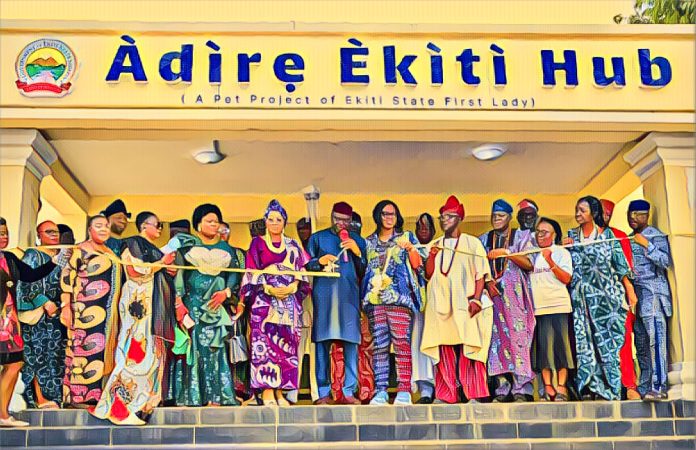
In a commendable stride towards combating unemployment and promoting cultural heritage in Ekiti State, Dr. Olayemi Oyebanji, the First Lady, has spearheaded the inauguration of the Adire Ekiti Hub. This initiative not only showcases the rich textile tradition of Nigeria but also paves a sustainable path for economic empowerment among the youth and widows in the region.
The Sun Nigeria recalled that the launch, held in the state’s capital, Ado-Ekiti, on March 5, 2024, marks a significant step in fostering entrepreneurship and preserving the art of Adire making—a traditional Yoruba fabric known for its vibrant patterns and cultural significance.
This groundbreaking project, unveiled in collaboration with the Nike Okundaye Art Foundation, aims to train around 600 individuals from across Ekiti’s three senatorial districts. With an equitable distribution of opportunities, each district is allocated 200 training slots, thereby ensuring widespread benefits from this initiative. The training kicked off with participants from Ekiti Central, with those from Ekiti South and Ekiti North set to commence their training sessions shortly.
Governor Biodun Oyebanji and his wife have shown a deep commitment to this cause, not just by sponsoring the program but also by partnering with an entity that embodies the essence of Nigerian art and culture. The Adire Ekiti Hub, encompassing a main building and workshop, was generously donated by Senator Babafemi Ojudu, an act that further signifies the collaborative effort towards the state’s socio-economic development.
The facility, blessed by the presence and endorsement of Olori Aderonke Ogunwusi, wife of the Ooni of Ife, stands as a testament to the potential within Ekiti State for creating sustainable livelihoods, fostering entrepreneurial spirit, and celebrating Nigeria’s rich cultural tapestry. The initiative is more than a training center; it is a beacon of hope, inspiring a community of skilled artisans and entrepreneurs poised to drive the growth and prosperity of Ekiti State.
Dr. Oyebanji, also the initiator of the Widows and Orphans Hope (WAOH) Project, envisions this hub as a crucible where the vibrant energy of the youth and the wisdom of the widows meld to rejuvenate the Adire industry, making it a cornerstone of the local economy. The beneficiaries of this project are set to undergo a comprehensive two-week training program, delving deep into the intricacies of the tie and dye art form, a skill set that promises to open doors to myriad economic opportunities.
Governor Oyebanji’s encouragement to the beneficiaries to seize this opportunity for self-reliance and economic contribution is a clarion call to move beyond the dependency on government palliatives. His administration’s pledge to support the trainees through mentorship, access to soft loans, and market strategies highlights a sustainable approach to empowerment, aiming to transform these individuals into independent entrepreneurs and job creators.
Senator Ojudu’s commendation of this initiative as a vital investment in the nation’s true wealth—its skilled people—resonates with the broader objective of economic resilience through skill development. Olori Ogunwusi’s insights underline the initiative’s role in skill acquisition, job creation, and wealth generation, emphasizing the hub’s alignment with the cultural heritage of the Yoruba people.
Chief Nike Okundaye’s acknowledgment of the Adire Ekiti Hub as a pivotal development in the creative economy underscores the project’s potential impact beyond Ekiti State. Her commitment, alongside Mrs. Nneka Moses of Goge Africa, to ensure that the hub serves as a springboard for empowerment and a beacon for the art of Adire making, sets a promising precedent for similar initiatives across Nigeria and beyond.
As the Adire Ekiti Hub takes its first steps, the collaborative effort of the Oyebanjis, the contribution of Senator Ojudu, and the endorsements by dignitaries like Olori Ogunwusi and Chief Okundaye, converge to weave a narrative of empowerment, cultural preservation, and economic development. This initiative stands as a shining example of how traditional arts can be leveraged to address contemporary challenges, crafting a future where culture and commerce coalesce to uplift communities and redefine economic landscapes in Ekiti State and Nigeria at large.

