

Key Points
- The National Bureau of Statistics recorded 3,381,228 internally displaced persons across 14 Nigerian states in 2023, with Borno State alone accounting for over 50 percent of the total.
- Benue and Katsina followed Borno in IDP numbers, while Gombe, Nasarawa and Kano recorded the lowest displacement figures among the 14 affected states.
- The NBS Demographic Bulletin 2023 also flagged 968 human trafficking cases, rising private sector job listings and a slight decline in skilled antenatal care access between 2018 and 2021.
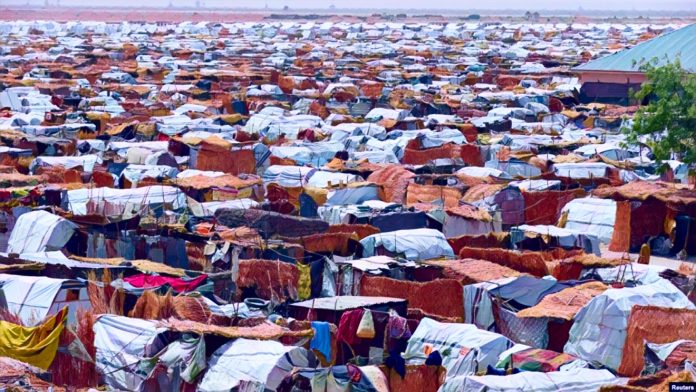
More than 3.3 million Nigerians were living as internally displaced persons in 2023, a fresh government report shows, with insurgency-battered Borno State shouldering more than half the national burden alone.
The National Bureau of Statistics released its Demographic Bulletin 2023 on Tuesday in Abuja, drawing on data from administrative sources and surveys to provide a statistical picture of the country’s population and social conditions.
The bulletin puts the total number of internally displaced persons at 3,381,228, spread across 14 states. Of that figure, Borno accounted for 50.62 percent, or 1,711,481 individuals, a number that reflects more than a decade of Boko Haram violence and military operations that have gutted communities across the state’s rural zones.
Benue came second with 11.67 percent, representing 394,567 displaced persons, a figure that tracks years of violent clashes between farming communities and armed herdsmen across the state’s local government areas. Katsina followed at 7.23 percent, or 244,380 individuals.
At the other end of the scale, Gombe, Nasarawa and Kano recorded the lowest IDP shares among the 14 states, with 52,383, 20,580 and 15,549 displaced persons respectively.
Population baseline
Beyond displacement, the bulletin pegs Nigeria’s projected total population at 221,250,127 in 2023, comprising 112,434,239 males and 108,815,888 females, based on National Population Commission figures.
Kano State ranked as the most populous at 15,671,491, followed by Lagos at 13,710,862 and Katsina at 10,661,373. Nasarawa and Bayelsa were the least populous states, with 2,948,849 and 2,583,352 residents respectively.
Health, trafficking and jobs
The bulletin flagged a quiet regression in reproductive health access. Skilled antenatal care coverage among women with a recent live birth climbed from 50 percent in 2011 to 67 percent in 2018, but slipped back to 63 percent by 2021.
Maternal conditions dominated healthcare spending in 2022, accounting for 50.22 percent of capital expenditure and 52.46 percent of recurrent spending, underscoring where the system is most strained.
On human trafficking, the NBS recorded 968 cases in 2023 covering foreign and domestic incidents. Foreign travel linked to prostitution accounted for the highest share at 173 cases, followed by procurement for sexual exploitation at 120 cases and buying and selling of persons for exploitation at 102 cases.
The labor market offered more encouraging signals. Private sector job advertisements tracked on the National Electronic Labour Exchange rose steadily from 90 in 2021 to 104 in 2022 and 150 in 2023, alongside a rise in registered employers on the platform.
Remittances
On diaspora flows, the United Kingdom remained Nigeria’s largest source of inward remittances in 2023 at $12.38 billion, down slightly from $12.76 billion in 2022. The United States recorded the highest outward remittance flow at $13.12 million in 2022.
The scale of internal displacement captured in the bulletin arrives as fresh attacks continue to push communities from their homes across Nigeria’s north and Middle Belt, suggesting the 2023 figures may already be an undercount of the current reality.

